

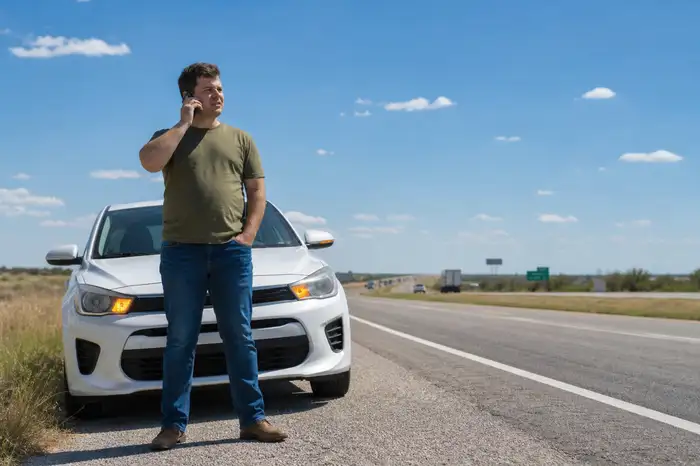
- Move to the right shoulder immediately and turn on hazard lights
- Stay in your vehicle with seatbelt on if it's unsafe to exit
- Call (817) 512-1024 — Texas Tows responds 24/7 on the DNT and surrounding tollways
- Never stand behind or directly beside your car on a tollway
- NTTA Incident Management patrols the DNT — they can push you to safety
Few driving situations are more stressful than a car breakdown on the Dallas North Tollway. The DNT — also known as the Dallas North Tollway (SH-190 spur and DNT main lanes) — carries over 200,000 vehicles per day through some of the busiest corridors in the Dallas metro, from downtown through Uptown, Oak Lawn, Northwest Dallas, and all the way north to Frisco. When your car breaks down here, you're not on a quiet side street — you're in fast-moving traffic with no curb, no parking lot, and drivers doing 65+ mph just feet from your door.
At Texas Tows Inc., our TDLR-licensed operators (license #0654316VSF) have been handling roadside breakdowns and tows on the DNT and every major DFW tollway since 2015. Here's exactly what to do if your car breaks down on the Dallas North Tollway — step by step, from the moment the engine sputters to the moment you're safely on your way.
Why Tollway Breakdowns Are Different
Breaking down on the Dallas North Tollway isn't like breaking down on a residential street. Several factors make it uniquely dangerous:
- High-speed traffic with no margin for error. The DNT main lanes operate at 65 mph speed limits, and drivers are often doing more. A vehicle stopped on the shoulder creates a serious hazard, especially at night or in rain.
- Barrier-separated lanes. In many DNT sections — particularly the express lanes through Uptown and the Galleria corridor — concrete barriers sit between the main lanes and the frontage road. If you break down in the express lanes, getting off is nearly impossible without a tow.
- Tolling infrastructure. Stopping for too long near a toll gantry can trigger automated enforcement cameras. Move past the gantry if at all possible before pulling over.
- Move-Over Law enforcement. Texas Transportation Code § 545.157 requires drivers to change lanes or slow down for vehicles stopped on the shoulder. However, compliance is inconsistent — Texas DPS data shows move-over violations are a leading cause of secondary crashes on Texas highways.
What to Do in the First 60 Seconds
How you respond in the first minute after a breakdown on the Dallas North Tollway determines your safety. Follow these steps in order:
- Don't panic — steer right immediately. The moment you feel the car losing power, losing a tire, or overheating, signal right and begin moving to the rightmost shoulder. Do not brake hard — ease off the gas and coast if possible.
- Activate hazard lights the moment you pull over. This is your first line of visibility. Texas law requires hazard lights for any stopped vehicle on a highway.
- Get as far right on the shoulder as possible. Ideally, your passenger-side tires should be off the pavement entirely. Even a few extra feet from live traffic significantly reduces the risk of a sideswipe.
- Keep your seatbelt on and stay in the vehicle — unless there is a fire, a smell of fuel, or another immediate danger. Research by AAA Foundation for Traffic Safety found that occupants are 2x more likely to be injured outside a stopped vehicle than inside it when traffic passes at highway speeds.
- Call for help. Dial (817) 512-1024 for Texas Tows 24/7 dispatch. Give your cross-streets or nearest landmark (e.g., "southbound DNT just past the Mockingbird Lane overpass").
- Turn your wheels toward the shoulder. If a passing vehicle hits you from behind, turned wheels will push your car away from traffic rather than into it.
NTTA Incident Management: What They Do (and Don't Do)
The North Texas Tollway Authority (NTTA) operates a fleet of Incident Management Vehicles on the Dallas North Tollway. These bright yellow trucks are dedicated to keeping traffic moving and helping stranded drivers. Here's what they can and cannot do:
What NTTA Incident Management can do:
- Push or tow your vehicle to the nearest emergency pull-off or frontage road ramp
- Provide a limited amount of gasoline to get you to the next exit
- Change a flat tire if you have a spare
- Jump-start a dead battery
- Call emergency services on your behalf
What NTTA Incident Management cannot do:
- Tow your vehicle to a repair shop or your home — they can only move you off the main lanes
- Provide mechanical repairs
- Offer a long-distance tow or transport service
- Replace major components (tires without a spare, belts, etc.)
In short: NTTA is your first responder on the DNT. But once you're off the main lanes, you still need a licensed tow company to handle the vehicle. That's where Texas Tows comes in. We're available 24/7 and dispatch quickly to DNT frontage roads, emergency pull-offs, and all tollway ramp exits from downtown Dallas through the Frisco and Allen corridors.
Calling for a Tow on the Dallas North Tollway
When you call Texas Tows for a car breakdown on the Dallas North Tollway, here's what happens:
- Dispatch locates you. Tell us your direction (northbound/southbound), the nearest cross street or exit, and any visible landmark. Common DNT reference points include the Galleria overpass, the Royal Lane junction, and the LBJ Freeway interchange.
- We assess the tow. Our dispatcher will ask about your vehicle type and whether it's drivable. For standard passenger cars, we typically deploy a flatbed truck. For specialty vehicles (AWD, lowered cars, luxury vehicles), we always use flatbed to protect your drivetrain and undercarriage.
- Fast response. With our team operating throughout North Dallas, we can typically reach most DNT locations within 30–45 minutes, often faster during off-peak hours.
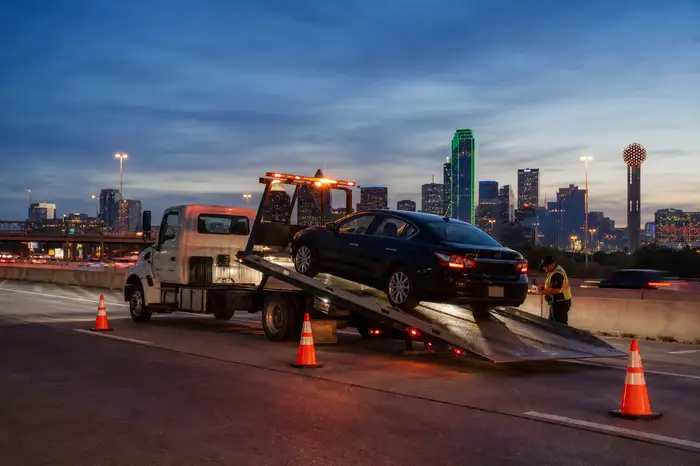
- Safe loading on the shoulder. Our TDLR-licensed operators are trained for highway shoulder work — we set out traffic safety cones, use proper lighting, and load quickly to minimize time in a live traffic zone.
Call (817) 512-1024 — Texas Tows is available 24/7. Our TDLR-licensed operators serve the full DNT corridor from downtown Dallas to Frisco.
You can also learn more about our Dallas towing service and roadside assistance options before you need them — it's worth saving our number now.
Common Breakdown Causes on the DNT
Our team handles hundreds of DNT breakdowns each year. These are the most common causes we see — and what you can do to prevent them:
1. Flat or Blown-Out Tires
The Dallas North Tollway has several stretches where road debris accumulates near on/off ramps, especially near the Galleria corridor and the LBJ/DNT interchange. A tire blowout at highway speed is one of the most dangerous breakdown scenarios. Regular tire pressure checks (monthly, especially before summer when heat expands air) are your best prevention. See our flat tire guide for Dallas highways for detailed step-by-step advice.
2. Engine Overheating
During Dallas summers — where temperatures regularly hit 100–105°F — engine cooling systems are under extreme stress. Stop-and-go traffic in the DNT express lanes through Uptown and Oak Lawn is a known trigger. If you see the temperature gauge rising, exit at the next ramp immediately. Do not wait until the needle is in the red.
3. Dead Battery or Electrical Failure
A car that simply stops starting or stalls unexpectedly is often an electrical issue — bad alternator, failing battery, or blown fuse. These tend to happen after extended idling in heavy DNT traffic near the Mockingbird or University Park exits.
4. Out of Fuel
It sounds avoidable, but Dallas traffic — especially the DNT corridor near the tollway plaza at Royal Lane — can stretch a "nearly empty" tank further than expected when you're sitting in gridlock. Keep your tank above a quarter when driving the tollway during rush hour. If you run out, our roadside assistance team can help — or call us for a fuel delivery in Dallas.
5. Transmission or Drivetrain Failure
Sudden loss of power to the wheels — especially in AWD and 4WD vehicles — is a serious breakdown that requires flatbed towing. Dragging an AWD vehicle even a short distance can cause catastrophic drivetrain damage.
Safety Mistakes to Avoid on the Dallas North Tollway
In over a decade of serving DFW drivers, our team has seen the same dangerous mistakes repeated at tollway breakdown scenes. Avoid these:
- Standing behind or next to the rear of your vehicle. This is the most dangerous position on a highway shoulder. If a passing driver clips your car, anything behind it becomes a secondary collision zone. Move to the front of the car (or to the roadway barrier/guardrail) while you wait.
- Trying to change a tire in live traffic. On the DNT, this is almost always avoidable and extremely dangerous. Pull to the frontage road ramp or emergency pullout if at all possible before attempting any tire change.
- Flagging down passing motorists. Pedestrian and vehicle interactions in tollway lanes are a significant hazard. Use your phone, not your arms.
- Accepting help from unlicensed tow trucks. The DNT corridor attracts predatory, unlicensed towing operators. If a tow truck appears before you called one, verify their TDLR license before allowing them to touch your vehicle. See our guide on spotting unlicensed tow trucks in Dallas.
- Turning off your hazard lights to "save battery." Your hazard lights use minimal battery. Keep them running until you are fully off the road.
Frequently Asked Questions
How long will Texas Tows take to reach me on the DNT?
Response times vary by traffic and time of day, but our team typically reaches most Dallas North Tollway locations within 30–45 minutes. We have operators positioned throughout North Dallas, University Park, and the Galleria area for faster DNT coverage.
Does NTTA charge me if their Incident Management team helps me?
No — NTTA Incident Management service is free to all toll road users. However, they can only move your vehicle off the main lanes. Any towing to a shop or your destination requires a licensed towing company.
Can I leave my car on the DNT shoulder while I wait?
Texas law (Texas Transportation Code § 545.305) gives police authority to remove any vehicle that is a traffic hazard. On high-speed toll roads, this can happen within 30–60 minutes. Call for a tow immediately rather than waiting to see if the car will start.
What if I broke down in the DNT express lanes?
The barrier-separated express lanes are the most dangerous breakdown scenario on the DNT. If you cannot exit to the right shoulder, activate hazards, call 911 to alert DPS, and immediately call Texas Tows. Do not exit the vehicle until emergency responders arrive and set up traffic control.
Does Texas Tows serve the full DNT corridor?
Yes — we cover the Dallas North Tollway from its southern terminus downtown through Uptown, Oak Lawn, Northwest Dallas, and north through Addison, Plano, and Frisco. We also serve connecting tollways including SH-121, President George Bush Turnpike, and I-635 (LBJ).
What type of tow truck do you use for tollway breakdowns?
We use flatbed trucks for the majority of tollway tows. Flatbed is the safest option for highway conditions — it eliminates the risk of dragging damage and allows faster, safer loading on narrow shoulders. For specialty vehicles like flatbed towing in Dallas, we always use our dedicated flatbed fleet.
Broke Down on the Dallas North Tollway?
Texas Tows is available 24/7. Our TDLR-licensed operators (license #0654316VSF) respond fast to the full DNT corridor — from downtown Dallas to Frisco. Save our number before you need it.
Call (817) 512-1024 Now4245 N Central Expy #490, Dallas, TX 75205
