

Quick Summary
Not every tow truck showing up in Dallas is operating legally. Unlicensed operators often have no TDLR decals, standard passenger car plates instead of a "Texas Tow Truck" plate, and inadequate insurance — putting your vehicle and your finances at serious risk. Here's exactly what to look for before you hand over your keys.
We heard it again just recently from one of our customers: they were stranded on the side of the road and a tow truck showed up — uninvited, unregistered, and completely unqualified. The driver had no idea how to safely load the vehicle, and the truck bore none of the markings required by Texas law. Calls are up, and unfortunately so are the number of unlicensed operators trying to cash in on stranded drivers across Dallas and the DFW area.
This post breaks down exactly how to tell a legitimate, state-licensed tow truck from one that has no business touching your car. Knowing the difference could save you thousands of dollars in vehicle damage — and a massive headache when filing an insurance claim that goes nowhere.
Why Unlicensed Tow Truck Operators Exist in Dallas
Texas requires tow truck operators to register with the Texas Department of Licensing and Regulation (TDLR) under the Towing and Storage industry program. This registration requires background checks, proof of liability insurance, proper equipment inspections, and the display of state-issued credentials on the vehicle. It's not optional — it's the law under the Texas Occupations Code Chapter 2308.
Despite that, unlicensed operators are common in high-traffic corridors across the Dallas metro — on I-35, I-635 (LBJ Freeway), I-30, and busy commercial areas from Oak Cliff to Richardson. They often scan police scanners or monitor traffic apps and race to accident scenes before a licensed operator can arrive. Some are opportunists; others are repeat offenders who know exactly what they're doing.
The result for drivers? Vehicles dropped incorrectly, transmissions damaged from improper hookups, and zero recourse when something goes wrong because the operator carries no qualifying insurance.
The "Texas Tow Truck" License Plate — The Fastest Check
This is the single easiest way to identify an unlicensed operator, and it's one our customers have started passing along to their friends and family: look at the license plate.
Every legally operating tow truck in Texas is required to display a specialty plate that reads "Texas Tow Truck." This plate is issued by the Texas Department of Motor Vehicles and is only available to operators who have completed TDLR registration. If you see a tow truck with a standard Texas passenger car plate, a commercial plate, or any plate that does not say "Texas Tow Truck" — that truck is not properly registered to operate as a tow truck in this state.
It sounds simple, and it is. Make it a habit: before you let anyone hook up your vehicle, walk around and look at the rear plate. If it doesn't say "Texas Tow Truck," something is wrong.
Quick Reference Checklist
- ✅ License plate reads "Texas Tow Truck"
- ✅ TDLR decal visible on driver's door or cab
- ✅ Company name and phone number clearly displayed
- ✅ Operator can provide proof of insurance on request
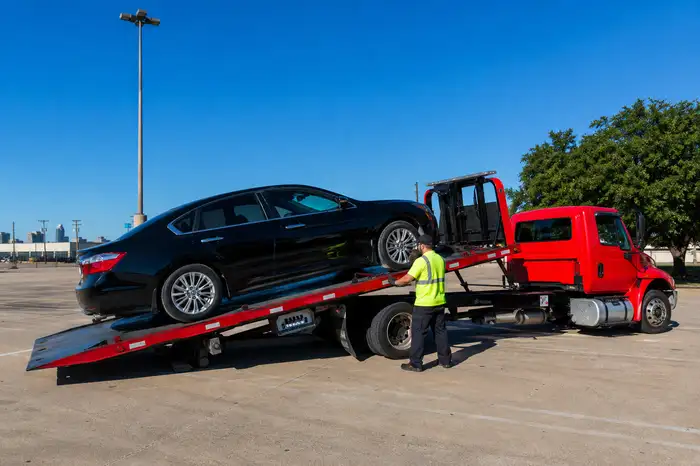
- ✅ Professional equipment — flatbed or proper wheel-lift rig
TDLR Decals: What They Are and Where They Should Be
In addition to the specialty plate, all TDLR-registered tow trucks must display a state-issued decal on the vehicle. This decal includes the company's TDLR license number and is typically placed on the driver's door or cab exterior. You can verify any tow company's TDLR license by searching the TDLR License Search — it's a free public database.
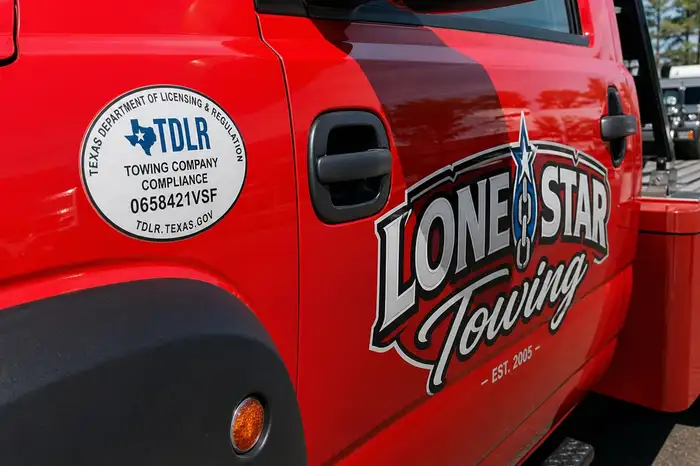
Texas Tows Inc. operates under TDLR license #0654316VSF. Our trucks are marked, our plates say what they're supposed to say, and our operators are trained and background-checked. When we pull up to your vehicle, you'll know exactly who we are before we touch your car.
Unlicensed operators, by contrast, have none of this. No decal. No verifiable license number. No state oversight. If something goes wrong during the tow — and with untrained operators using improper equipment, things do go wrong — there is no accountability trail.
The Insurance Gap: Why This Puts You at Financial Risk
Here's where the stakes get real. TDLR registration requires tow operators to carry specific liability insurance that covers damage to your vehicle during the towing process. Unlicensed operators either carry no insurance at all or carry a basic commercial auto policy that expressly excludes towing operations — meaning if your car gets damaged, you have no claim.
We've heard stories from Dallas drivers who handed their keys to an unlicensed operator, watched their car get improperly loaded onto a hook rig, and ended up with a bent subframe, damaged drivetrain, or worse. When they tried to file a claim, there was nothing to file against. The operator had vanished, the "company" turned out to be a single guy with a pickup truck, and the insurance certificate he provided was either invalid or didn't cover towing liability.
Your own auto insurance may cover some damage caused by third parties, but proving liability and navigating that process takes months. The simplest protection is never letting an unlicensed operator touch your vehicle in the first place.
Other Red Flags on Scene
Beyond the plate and decals, here are additional warning signs that a tow truck operator may not be legitimate:
- They showed up uninvited. If you didn't call a tow company and one appears at your breakdown scene, be cautious. "Bandit towing" — where operators scan for stranded drivers — is illegal in Texas for non-consent tows on public roads in many circumstances. Always confirm you requested the service.
- No company name on the truck. Licensed operators are required to display their company name and contact information on the vehicle. An unmarked truck or one with magnetic signs that look like they were just slapped on is a red flag.
- Pressure to decide immediately. A legitimate operator won't rush you or demand you make a decision under duress. If someone is pressuring you to sign paperwork quickly on the side of I-35 or LBJ Freeway, slow down and call the police non-emergency line if needed.
- No written estimate or receipt. Texas law requires tow operators to provide written notice of charges before towing (in most circumstances). If the driver refuses to give you anything in writing, that's a serious red flag.
- Improper equipment for your vehicle. A licensed, trained operator will assess your vehicle before attaching anything. If someone immediately hooks a chain to your bumper or starts rigging up your AWD vehicle without asking about drivetrain type, they don't know what they're doing.
What to Do When You Need a Tow in Dallas
The best defense is a proactive plan. Save a licensed tow company's number in your phonebefore you need it. That way, when you're stranded on the side of Central Expressway near SMU, dealing with a flat on Harry Hines, or stuck after a fender-bender in Uptown, you don't have to make a snap decision about who to trust.
Texas Tows Inc. serves the entire Dallas metro — from North Dallas and Preston Hollow down through Lower Greenville, the Medical District, Oak Lawn, and into surrounding communities. We run 24/7 towing, flatbed towing for specialty and low-profile vehicles, and full roadside assistance — all from TDLR-licensed, insured, trained operators who show up in properly marked, registered trucks.
When you're in a tough spot, the last thing you need is a second problem caused by the wrong tow company. Give us a call at (817) 512-1024 — we'll be there fast, and you'll know exactly who's handling your vehicle from the moment we arrive.
Need a Licensed Tow in Dallas Right Now?
Texas Tows Inc. — TDLR Licensed #0654316VSF — Available 24/7 across the DFW Metro
Call (817) 512-1024Frequently Asked Questions
How do I verify a tow truck is licensed in Texas?
Check the license plate — it should read "Texas Tow Truck." Then look for a TDLR decal on the cab or door. You can also search the operator's TDLR number at tdlr.texas.gov/LicenseSearch to confirm their registration is active.
Is it illegal to operate a tow truck without a TDLR license in Texas?
Yes. Operating a tow truck in Texas without TDLR registration is a violation of the Texas Occupations Code and can result in civil penalties. You have the right to refuse service from an unlicensed operator.
What if an unlicensed tow truck damaged my vehicle?
Start by documenting everything — photos of the damage, any "company" information from the truck, and the driver's name or plate number if possible. File a complaint with TDLR and contact your auto insurance carrier. You may also have civil legal recourse depending on the circumstances.
Does Texas Tows Inc. serve the whole Dallas area?
Yes — we cover Dallas proper and the broader DFW metro, including North Dallas, Preston Hollow, Lake Highlands, the Medical District, SMU/University Park, Lower Greenville, and many surrounding cities. Call us at (817) 512-1024 to confirm coverage in your location.
What type of tow truck is safest for my vehicle?
For most passenger vehicles, AWD vehicles, luxury cars, and low-profile sports cars, a flatbed tow truck is the safest option. All four wheels are off the ground, eliminating drivetrain risk. Texas Tows Inc. runs a full fleet of flatbed trucks for exactly this reason.
