

If you've ever jumped into your car on a scorching Dallas afternoon, turned the key, and heard nothing but a click — you've experienced what thousands of DFW drivers face every summer. Your car battery Dallas summer situation isn't just bad luck. It's predictable, and it's largely preventable.
Dallas summers are among the most punishing in the country. June through August, temperatures routinely exceed 100°F, and the heat index on asphalt can push 130°F or higher. Most drivers think of dead batteries as a cold-weather problem — but our roadside technicians at Texas Tows see the opposite. Dead battery calls spike every summer across the DFW metroplex, from Irving and Arlington to Plano and Mesquite.
This guide explains exactly why extreme Texas heat destroys car batteries, the warning signs every Dallas driver should know, and what you can do to avoid being stranded on I-35 or the Dallas North Tollway when temps are peaking.
Why Heat — Not Cold — Is the Real Battery Killer
Conventional wisdom says cold kills batteries. And while cold does reduce a battery's cranking power in the short term, heat is the primary cause of permanent battery damage and premature failure. The Battery Council International estimates that heat cuts the average battery lifespan by 33–50% in hot climates compared to moderate ones.
Here's the chemistry: a standard lead-acid car battery works through a chemical reaction between lead plates and sulfuric acid electrolyte. Heat accelerates this reaction — which sounds productive until you realize it also accelerates every negative side effect:
- Electrolyte evaporation: High temperatures cause the water in your battery's electrolyte solution to evaporate, lowering fluid levels and exposing the lead plates to air.
- Plate corrosion: Exposed plates corrode faster, permanently reducing the battery's ability to hold a charge.
- Internal resistance buildup: Heat accelerates sulfation — the buildup of lead sulfate crystals on the plates — which increases internal resistance and reduces charge capacity over time.
- Separator damage: The separators between battery plates can warp or melt under extreme heat, causing internal short circuits.
A battery that might last five years in a temperate climate may fail in two to three years in Dallas. If your battery is already three years old heading into June, it's at elevated risk.
How Dallas Summer Conditions Make It Worse
Dallas doesn't just get hot — it stays hot. Unlike coastal Texas cities that cool off at night, DFW can hold temperatures in the mid-90s well after sundown during July and August. That means your battery never gets a break.
Add to this the urban heat island effect: parked on concrete or asphalt in a Dallas surface lot or parking garage, under-hood temperatures can climb to 170°F or higher. Your battery sits just inches from the engine block and is exposed to both ambient heat and heat generated by the engine itself.
Combine that with:
- Air conditioning load: Running the A/C constantly puts sustained electrical demand on the battery and alternator, accelerating wear.
- Stop-and-go traffic: I-35, I-635 (LBJ Freeway), and the Dallas North Tollway are congested during summer heat. Idling in traffic means the alternator isn't charging the battery as efficiently as highway driving.
- Short trips: Dallas errand runs that are 5–10 minutes don't give the alternator enough time to fully recharge the battery after startup.
Warning Signs Your Car Battery Is Failing in Dallas Summer
Batteries rarely die without warning. Watch for these signs — especially heading into peak summer months:
- Slow engine crank: If the engine turns over sluggishly before starting (especially after sitting in the sun), the battery is struggling. This is the #1 early warning sign.
- Dashboard battery or check engine light: A battery warning light almost always means the battery or charging system needs attention. Don't ignore it.
- Swollen or bloated battery casing: Heat causes gases to build up inside the battery. A casing that looks puffy or warped is a sign of thermal damage — replace it immediately.
- Rotten egg / sulfur smell: This indicates the battery is overcharging or venting hydrogen sulfide gas — a dangerous condition. Get off the road safely and call for assistance.
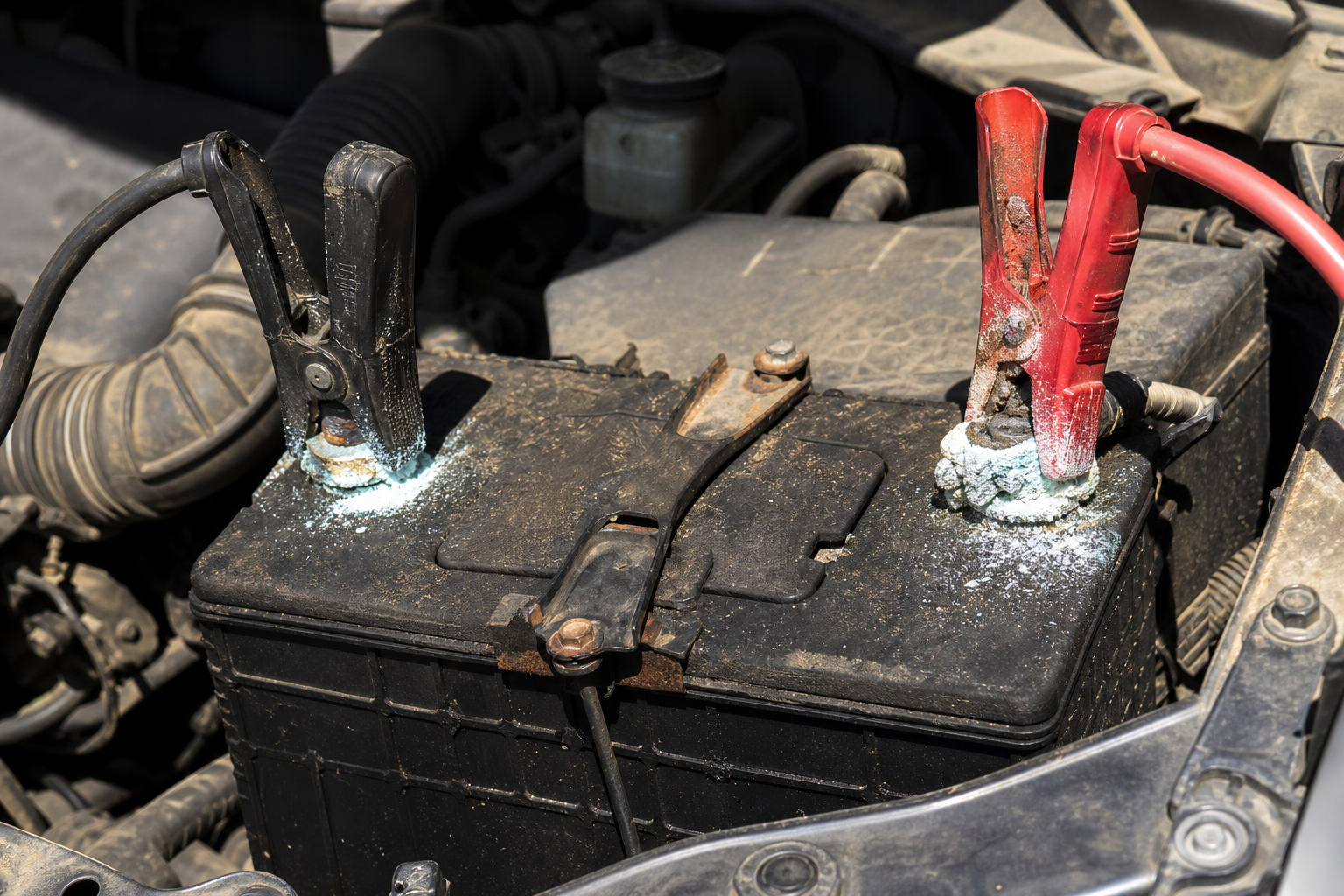
- Corroded terminals: White or blue-green buildup on battery terminals increases resistance and reduces charge transfer. Corrosion also accelerates in heat.
- Electrical issues: Flickering headlights, slow power windows, or radio/infotainment that resets can all indicate a failing battery unable to maintain consistent voltage.
- Battery age over 3 years: In Dallas, treat a 3+ year old battery as end-of-life during summer months. The failure risk rises sharply.
How to Prevent Car Battery Failure in Dallas Summer
The good news: battery failure in Dallas summer is largely preventable with a little proactive attention.
- Test your battery before summer hits. Most auto parts stores (AutoZone, O'Reilly, Advance) will test your battery for free. If it tests below 12.4 volts at rest or shows reduced cold cranking amps (CCA), replace it before June.
- Park in shade or covered parking whenever possible. Under-hood temperature drops dramatically when the car is out of direct sunlight. Even a carport reduces battery stress significantly.
- Clean battery terminals regularly. A mixture of baking soda and water, applied with an old toothbrush, removes corrosion and improves electrical contact. Do this every 3–6 months.
- Minimize short trips. If you can combine errands, do it. Short trips that don't allow the alternator to recharge the battery fully lead to progressive discharge over time.
- Turn off accessories before shutting down. A/C, headlights, and infotainment that run after the engine shuts off draw down battery reserve. Make it a habit to turn them off first.
- Consider a battery with higher heat tolerance. AGM (Absorbed Glass Mat) batteries are significantly more resistant to heat damage than standard flooded lead-acid batteries. If you're replacing a battery in Dallas, AGM is worth the upgrade.
What to Do When Your Battery Dies in Dallas
Even with preparation, batteries can fail without warning — especially in extreme heat. If you're stranded in Dallas, here's what to do:
- Move to safety first. If you lose power while driving, signal and coast to the shoulder of I-35, I-30, or whichever road you're on. Turn on hazard lights immediately. In DFW traffic, staying visible is critical.
- Do not attempt to restart a swollen or leaking battery. If the casing is visibly damaged or you smell sulfur, call for professional help.
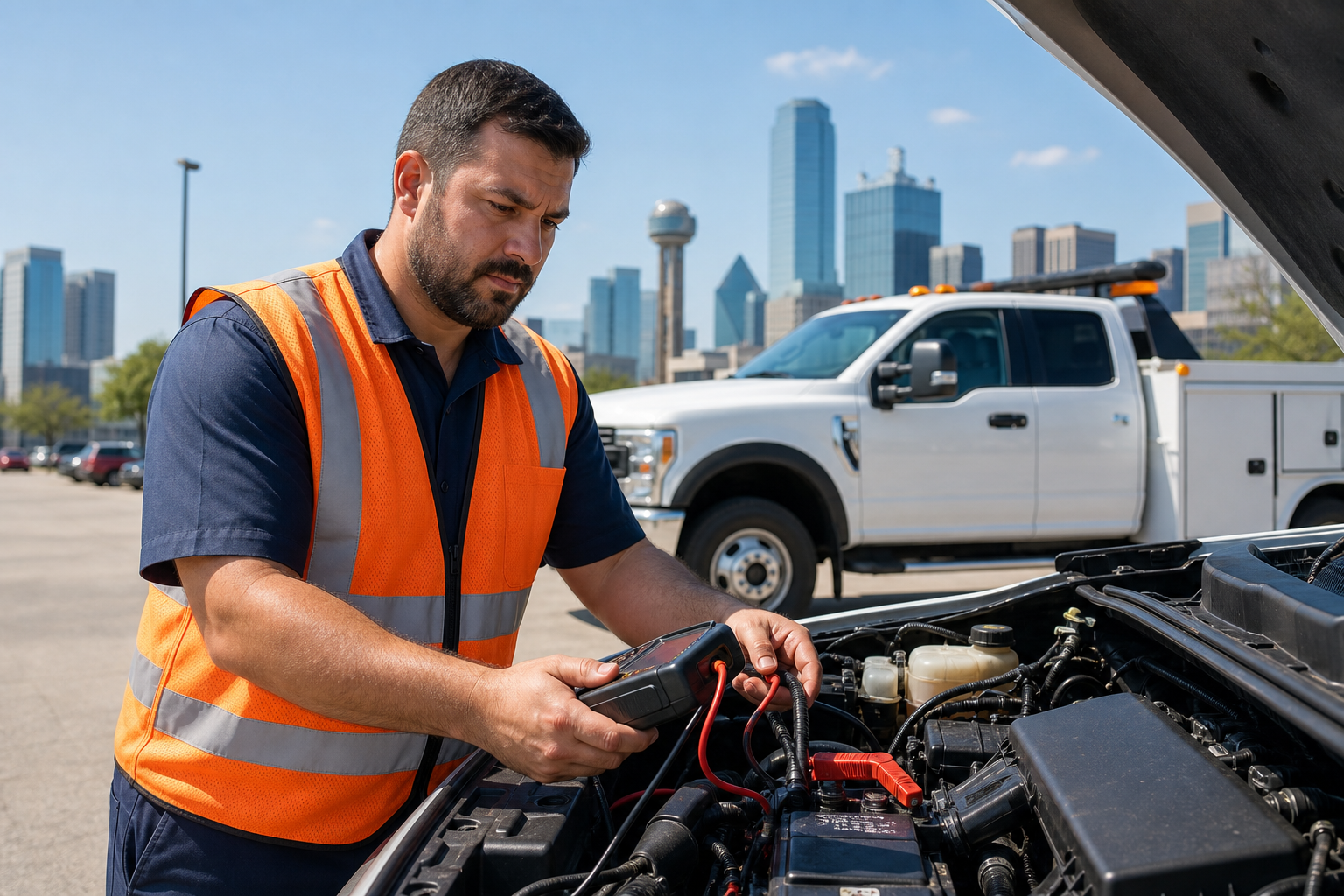
- Call Texas Tows for roadside assistance. Our roadside assistance team can coordinate a tow to your preferred shop or dealer when a battery issue leaves your vehicle undriveable.
- Stay in your vehicle on highways and in unsafe areas. On well-lit surface streets, stepping out is fine. On I-35, I-635, or I-20, remain inside with your seatbelt on until help arrives.
If your vehicle starts after cooling down, drive directly to an auto parts store or mechanic for a battery test — recurring battery trouble in Dallas summer heat is a sign it may be nearing the end of its life. Don't park it for the night and expect it to start in the morning.
And if you need a tow to a shop, our towing service covers all of DFW — from Dallas proper to Fort Worth, Plano, Irving, Garland, and everywhere in between.
FAQs: Car Battery Questions for Dallas Summer
How long does a car battery last in Dallas heat?
In Dallas, expect 2–4 years from a standard lead-acid battery and 4–6 years from a quality AGM battery. Compare that to 5–7 years in cooler northern climates. If your battery is approaching 3 years old in Dallas, test it before summer.
Can heat alone kill a car battery without any warning?
Yes, especially in older batteries. Heat can cause a sudden internal short circuit that kills the battery with almost no advance warning. However, most batteries do show subtle signs first — slow cranking, occasional hesitation — that get ignored. Pay attention to how your car starts.
Should I buy an AGM battery for my Dallas vehicle?
If your budget allows, yes. AGM batteries handle heat and repeated deep discharge cycles significantly better than standard flooded batteries. They're particularly worth it if you drive a newer vehicle with significant electrical loads (start-stop systems, multiple screens, heated/cooled seats).
Is it safe to handle a hot battery in summer?
A visibly swollen, cracked, or leaking battery is not safe to handle — the risk of hydrogen gas ignition or acid spatter is real. When in doubt, call a professional and arrange safe transport to a repair facility.
Can I prevent my battery from dying in extreme heat?
You can significantly reduce the risk. Park in covered parking, keep terminals clean, test your battery annually (or semi-annually in Dallas), and replace batteries proactively after 3 years. No battery lasts forever in DFW heat, but proper maintenance can prevent most preventable failures.
Texas Tows: 24/7 Battery Help Across DFW
Texas Tows Inc. has been helping stranded Dallas drivers since 2015. Our TDLR-licensed technicians respond 24 hours a day, seven days a week — including peak summer hours when batteries are most likely to fail.
Whether you need a tow from a Plano parking garage at midnight, a tow from the shoulder of I-30 in Fort Worth, or safe transport for a battery assessment before the summer gets worse, we're the local team that knows DFW roads and responds fast.
Call us at (817) 512-1024 — we're available right now.
Learn more about our 24/7 roadside assistance services or read our guide on what to do with a dead battery in Dallas for step-by-step instructions.
