

A crash has just happened on I-75 or the LBJ Freeway. Airbags deployed, adrenaline is pumping, and a tow truck is on the way. Then the question nobody wants to deal with at the scene hits you: who actually pays for this?
In Texas, the answer depends on several things — who was at fault, what insurance coverage you carry, and whether you know your rights under state law before you sign anything. Here's everything you need to know before the truck shows up.
Texas Is an At-Fault State — What That Means for Towing
Texas follows a modified comparative fault rule. The driver whose negligence caused the accident is responsible for resulting damages — including towing costs. In a clear-cut at-fault crash, the at-fault driver's liability insurance should cover your tow bill as part of the property damage claim.
However, "should" and "will immediately" are two very different things. Liability claims go through an adjuster process that can take days. That means you may need to pay the tow upfront and seek reimbursement — or use your own coverage to avoid waiting.
Can You Call a Tow Before Police Arrive in Texas?
Yes — and this is a legal right many Dallas drivers don't know they have. Under Texas law, you are not required to wait for law enforcement before arranging a tow for a non-injury crash. In fact, for non-injury accidents in Dallas, DPD response times routinely run 45–90+ minutes for non-emergency calls. Waiting is optional.
If you need to document the scene for insurance purposes, take photos immediately — the four corners of each vehicle, the full intersection or freeway stretch, any road markings, and damage close-ups — then call a licensed tow. You do not need to wait for a police report before moving a damaged vehicle in Texas.
Exception: if there are injuries, fatalities, or the vehicles are blocking active traffic lanes on a highway like I-635 or I-30, emergency services should be your first call.
What Does the At-Fault Driver's Insurance Cover?
In Texas, all drivers are required to carry minimum liability insurance: 30/60/25. The property damage portion (the "$25" in 30/60/25 — meaning $25,000 per accident) covers damage to the other party's vehicle. That includes towing.
If the other driver is at fault, you file a third-party liability claim with their insurance. The adjuster will authorize a tow or reimburse you if you've already paid. Keep your receipt and document the tow company's name, driver, and time of service.
The catch: if the at-fault driver is uninsured or underinsured — which affects roughly 1 in 8 Texas drivers — you need your own coverage to fall back on.
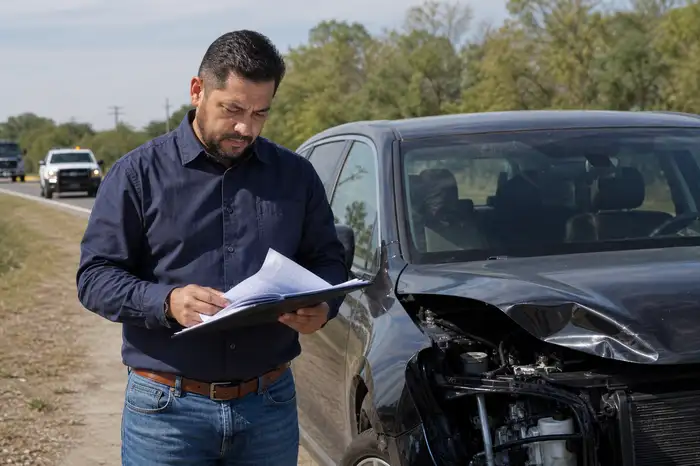
Your Own Insurance Options After a Dallas Accident
Texas drivers aren't required to carry comprehensive or collision coverage — but if you have it, it matters here:
- Collision coverage pays for your vehicle's repair or replacement regardless of fault. Towing is typically included or available as a rider. Your insurer arranges the tow or reimburses it. You pay your deductible.
- Roadside assistance endorsement (often through GEICO, State Farm, USAA, etc.) covers tows for breakdowns and accidents. Check your policy — some explicitly exclude accident tows or limit reimbursement to specific amounts.
- Uninsured/Underinsured Motorist (UM/UIM) property damage covers your vehicle when the at-fault driver has no insurance or not enough. This can apply to towing costs as well.
- Motor club memberships (AAA, AARP, etc.) typically cover towing up to a set mileage regardless of cause — accident or mechanical breakdown.
Your Rights Under Texas Towing Law (TX Occ Code Ch. 2308)
Texas Occupations Code Chapter 2308 gives you specific legal rights when dealing with any tow company — whether the tow was arranged by you or dispatched by authorities.
- Written estimate required: Before towing begins (if you are present), the towing company must provide a written itemized estimate of charges if you request one. Never waive this. Get the rate for the base hook, per-mile charge, and storage fees separately.
- Consent tow vs. non-consent tow: A consent tow is one you authorize. A non-consent tow is dispatched by police or a property owner without your direct approval. Non-consent tows are subject to stricter price controls set by the Texas Department of Licensing and Regulation (TDLR).
- Right to choose your tow company: If you are present and able to make the call, you have the right to choose which licensed towing company handles your vehicle. Police rotational lists are used when the owner is not present or incapacitated — not to override your choice.
- Storage fees and access: If your vehicle is taken to a storage facility, the operator must allow you access to retrieve personal property within 24 hours, even if you cannot pay the storage fee immediately.
Texas Tows Inc. is TDLR-licensed (license #0654316VSF), which means every charge on every tow is compliant with state regulations. Ask to see credentials before signing anything with any tow operator.
Accident on I-75, I-635, or I-30 in Dallas? A Note on Police-Dispatched Tows
On major Dallas highways, DPD or TxDOT may dispatch a tow from their rotation list if vehicles are blocking traffic. You are not obligated to use that company's storage yard indefinitely. Once your vehicle is accessible, you can arrange a secondary tow to a repair shop of your choice. Secondary towing from a storage yard is a specialized service — flatbed is usually required for crash-damaged vehicles to prevent further drivetrain damage.
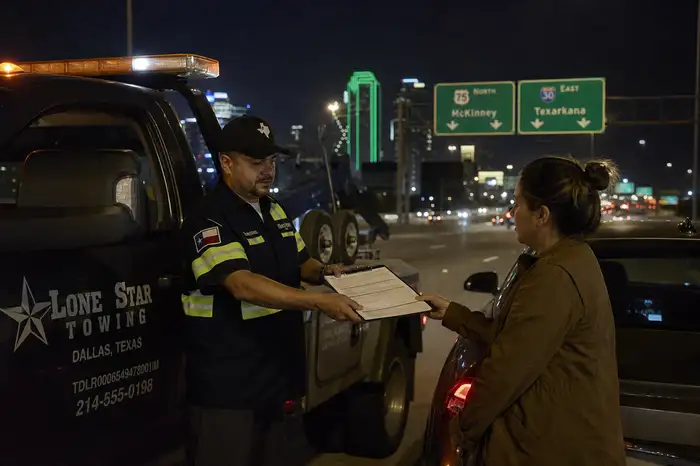
Step-by-Step: Who Pays What After a Dallas Crash
- At-fault driver hit you? File a third-party property damage claim with their liability insurer. Provide tow receipt. Expect reimbursement once adjuster approves — typically 3–7 business days for straightforward claims.
- You were at fault (or unclear)? Use your collision coverage. Your insurer handles the tow or reimburses. You pay the deductible.
- Other driver uninsured? Use UM/UIM property damage if you carry it, or collision. File an uninsured motorist claim simultaneously.
- Dispute over fault? Pay the tow out of pocket, keep every receipt, and let the insurance subrogation process sort out reimbursement. Do not delay the tow waiting for fault to be determined.
What to Gather at the Scene (Towing-Specific)
Insurance adjusters will ask for documentation. Capture all of this before the tow truck leaves:
- Tow company name, TDLR license number, and driver name
- Written itemized estimate (or photograph of any verbal quote given)
- Storage yard address where your vehicle is being taken
- Time tow was dispatched and time vehicle left the scene
- Photographs of your vehicle's condition before loading
If you're calling Texas Tows, our TDLR-licensed operators will walk you through this — it's standard practice on every call. Reach us 24/7 at (817) 512-1024.
Final Word: Know Your Rights Before the Truck Arrives
Post-accident stress makes it easy to just sign whatever is put in front of you. Don't. Texas law gives you real protections — the right to choose your tow company, the right to a written estimate, and the right to access your vehicle's personal property regardless of unpaid storage fees. Use them.
And if you're on I-75, I-635, the North Dallas Tollway, or I-30 in the Dallas metro, Texas Tows Inc. has been serving the area since 2015 with flatbed equipment capable of handling everything from compact sedans to SUVs and trucks — safely, legally, and transparently.
Related: What to Do After a Car Accident in Dallas | Does Insurance Cover Towing After an Accident? | Accident Recovery Service | Flatbed Towing
