

- In Texas, you do not have to wait for police at non-injury accidents — file a self-report instead.
- Dallas PD non-injury response times can run 45–90+ minutes on busy corridors.
- You have the legal right to choose your own tow company — don't let a rotation-dispatch truck take your car.
- Crash-damaged vehicles almost always need flatbed towing to prevent further drivetrain damage.
- Texas Tows TDLR license: #0654316VSF | 24/7 Dallas coverage | (817) 512-1024
A car accident is disorienting even when everyone walks away unhurt. You're dealing with adrenaline, traffic, and a dozen decisions at once — all while standing on the shoulder of I-75 or the LBJ Freeway. Knowing exactly what steps to take ahead of time can protect your safety, your legal rights, and your car.
At Texas Tows Inc., our TDLR-licensed operators (#0654316VSF) have been responding to accident scenes across Dallas and DFW since 2015. We've seen what goes wrong when drivers don't know their rights — and we've put this guide together so you're never caught off guard.
Step 1: Check for Injuries and Move to Safety
Your first priority is people, not property. Check yourself, your passengers, and — if safe — the occupants of the other vehicle. If anyone is injured, call 911 immediately. Do not move injured people unless there is an immediate danger (like fire).
If the vehicles are drivable and the collision happened in a lane of traffic, move to the shoulder or a nearby parking area. This is especially important on high-speed Dallas corridors like I-75 / North Central Expressway, I-635 / LBJ Freeway, and the North Dallas Tollway, where secondary accidents from stopped vehicles are a genuine risk.
Turn on your hazard lights. If you have road flares or reflective triangles, deploy them at least 50–100 feet behind your vehicle. The Texas Transportation Code (§ 547.507) requires warning devices for stopped vehicles on high-speed roadways.
Step 2: Do You Have to Wait for Police in Texas?
Here's something many Dallas drivers don't know: you are not required to wait for police at a non-injury accident in Texas.
Under Texas Transportation Code § 550.062, if an accident results only in property damage and no injuries, you can move vehicles out of traffic and file a self-report form (Texas CR-2) directly with the Texas Department of Transportation within 10 days. You do not need to wait for an officer to respond.
Why does this matter in Dallas? Because Dallas PD response times for non-injury accidents routinely run 45–90+ minutes on busy corridors, particularly during morning and evening rush on I-30 / East RL Thornton Freeway and I-75 during peak hours. Standing on the highway shoulder for 90 minutes is far more dangerous than exchanging information and leaving.
When you DO need to stay and wait for police:
- Anyone in any vehicle is injured
- A vehicle is undrivable and blocking a lane
- You suspect the other driver is impaired
- The other driver is uninsured or uncooperative
- There is significant property damage (Texas law requires a police report for accidents above $1,000 in damage)
When in doubt — call 911 and let the dispatcher advise you.
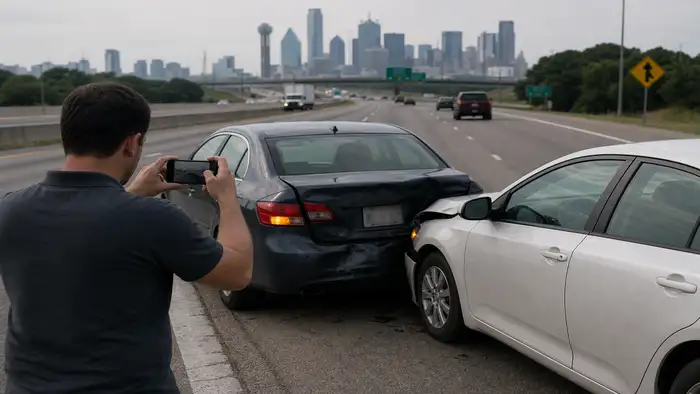
Step 3: Document Everything at the Scene
Whether police respond or not, document the scene thoroughly before vehicles are moved (if safely possible):
- Photos: All vehicle damage (every angle), license plates, VINs if visible, surrounding road conditions, skid marks, nearby intersections or highway mile markers
- Other driver's info: Full name, driver's license number, insurance company + policy number, vehicle make/model/plate
- Witness info: Names and phone numbers of any witnesses
- Time and location: Exact time, street name or highway + mile marker, direction of travel
- Weather and road conditions: Note any relevant factors (wet road, construction zone, poor lighting)
If police do respond, get the officer's name, badge number, and the accident report case number. Dallas PD reports can be obtained through the Dallas Police Department online portal within 5–10 business days.
Step 4: Who Tows Your Car After an Accident in Dallas?
This is where many accident victims lose hundreds — or thousands — of dollars unnecessarily.
You have the legal right to choose your own tow company in Texas — even after an accident. Police cannot compel you to use a specific rotation-dispatch company. Non-consent towing laws in Texas (Texas Occupations Code Chapter 2308) regulate predatory towing, and your right to select your own tow applies even when officers are on scene.
When police call a tow, they typically use a rotation-dispatch list — trucks in the queue who respond regardless of your location or needs. These companies are often significantly more expensive than calling a licensed tow company of your choice.
Your rights at an accident scene:
- You may call any licensed tow company to respond
- You do not have to accept the first rotation-dispatch truck that arrives
- All tow trucks operating in Dallas must be TDLR-licensed — ask to see the license if you're unsure
- Storage fees begin accruing once your vehicle is in their lot — pick it up promptly
- Get an itemized receipt before your vehicle is towed
Texas Tows responds 24/7 across Dallas, including the Medical District, Lake Highlands, and North Dallas. Our operators are fully TDLR-licensed (#0654316VSF), and we use flatbed trucks for all accident recovery — your vehicle won't sustain additional damage in transit.
Call us directly at (817) 512-1024 before accepting any rotation-dispatch truck.
Step 5: Notify Your Insurance Company
Contact your insurance company as soon as practical — ideally within 24 hours of the accident. Most policies require "prompt" notification as a condition of coverage. Delayed reporting can complicate or void claims.
When you call:
- Give the date, time, and location of the accident
- Provide the other driver's insurance and plate info
- Describe the damage to your vehicle
- Tell them whether you'll need a tow and/or a rental vehicle
Your insurer may recommend a specific body shop. You have the right to decline and choose your own repair facility. Texas law prohibits insurers from requiring you to use a specific shop.
If the other driver was at fault, you may file a claim with their insurance company (third-party claim) rather than your own. Your attorney or insurance agent can advise on which path is faster given your specific situation.
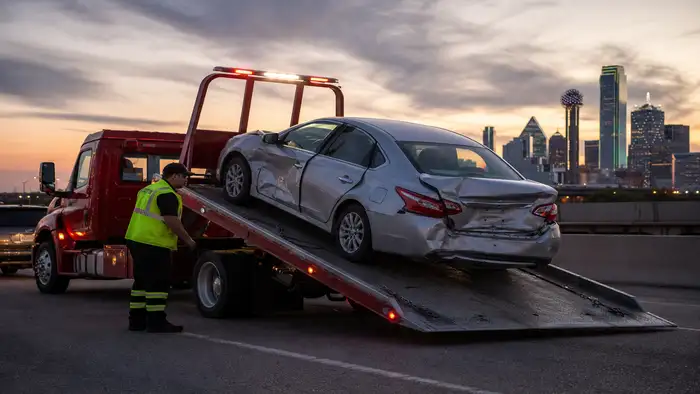
Why Crash-Damaged Cars Need Flatbed Towing
Not all tow trucks are equal when it comes to accident recovery. A standard wheel-lift or dolly tow — where two wheels stay on the ground — can cause serious additional damage to a crash-damaged vehicle:
- AWD and 4WD vehicles will sustain drivetrain damage if towed without all four wheels lifted
- Bent frames can shift and bind further when dragged behind a wheel-lift
- Airbag sensors and post-crash safety systems can trigger if the vehicle is jostled incorrectly
- Leaking fluids (transmission, brake, coolant) can contaminate the tow truck and road
Our accident recovery service uses flatbed trucks exclusively for crash scenes. The entire vehicle is loaded and transported flat — no wheels on the road, no additional stress on the frame or drivetrain. This is the industry standard for accident towing, and it's what your insurance company expects.
Need flatbed towing in Dallas? Call (817) 512-1024 — we're available around the clock.
Frequently Asked Questions
Do I have to call the police after a minor accident in Dallas?
For non-injury accidents in Texas, you are not required to wait for police. You can exchange information and file a Texas CR-2 self-report form within 10 days. However, if there are injuries, an uninsured driver, or significant damage, calling 911 is the right move.
Can I choose my own tow company after an accident in Texas?
Yes. Texas law gives you the right to choose your own licensed tow company, even when police are on scene. Call Texas Tows directly at (817) 512-1024 before accepting a rotation-dispatch truck — you'll typically get better rates and service.
How long does Dallas PD take to respond to a non-injury accident?
Dallas PD non-injury accident response times vary widely — 45–90 minutes is common on busy corridors during peak hours. On I-75, I-30, and I-635, this can stretch longer during rush hour. For non-injury crashes, you can legally move vehicles and file a self-report rather than waiting on the shoulder.
What is a Texas CR-2 form?
A Texas CR-2 is the Driver's Crash Report — a self-report form filed with TxDOT for crashes involving only property damage (no injuries). It must be filed within 10 days of the accident. Download the form from the TxDOT website.
Will my insurance cover towing after an accident?
Most comprehensive auto insurance policies include roadside assistance and towing coverage. After an accident, towing is typically covered under your collision coverage or the at-fault driver's liability coverage. Always get an itemized tow receipt and report the tow to your insurer.
What's the difference between accident towing and regular towing?
Accident towing involves recovering a crash-damaged vehicle — which often requires specialized equipment, flatbed trucks, and trained operators who understand how to load a damaged vehicle safely. Regular towing for a breakdown is typically simpler. See our accident recovery service page for details.
Texas Tows Inc. has served Dallas since 2015 with TDLR-licensed operators, flatbed trucks, and 24/7 availability. After an accident on I-75, I-30, I-635, or anywhere in the DFW area — call us first: (817) 512-1024.
