

If your all-wheel-drive or four-wheel-drive vehicle breaks down on a Dallas highway, the first thing you need to know is this: how it gets towed matters enormously. A standard wheel-lift tow truck — the kind that lifts from the front or rear wheels — can cause serious, permanent damage to your drivetrain if your vehicle has AWD or 4WD.
At Texas Tows Inc., our TDLR-licensed operators (license #0654316VSF) have been serving Dallas drivers since 2015. We field calls every week from drivers whose AWD trucks or SUVs were towed incorrectly by operators who didn't know — or didn't care — about the difference. Here's what you need to know before you call for a tow.
Why AWD and 4WD Vehicles Require Special Handling
In a standard two-wheel-drive vehicle, the drivetrain is only connected to one axle. If you lift the drive wheels off the ground, the rest of the vehicle can roll freely without transmitting torque through the transmission.
With AWD and 4WD vehicles, that's not the case. The transfer case, front and rear differentials, and driveshafts are all mechanically linked. When an AWD vehicle is towed with only two wheels on the ground — the typical wheel-lift method — the rolling wheels spin those linked components without engine oil circulation.
The result? Dry bearings, overheated differentials, and in serious cases, complete transfer case failure. Repair bills can run from $1,500 to over $5,000.
Dallas is full of AWD and 4WD drivers. Between the pickup trucks on I-35 and the luxury SUVs in Preston Hollow and Highland Park, our fleet handles these vehicles constantly. Knowing how to do it right isn't optional — it's essential.
The Right Way: Flatbed Towing
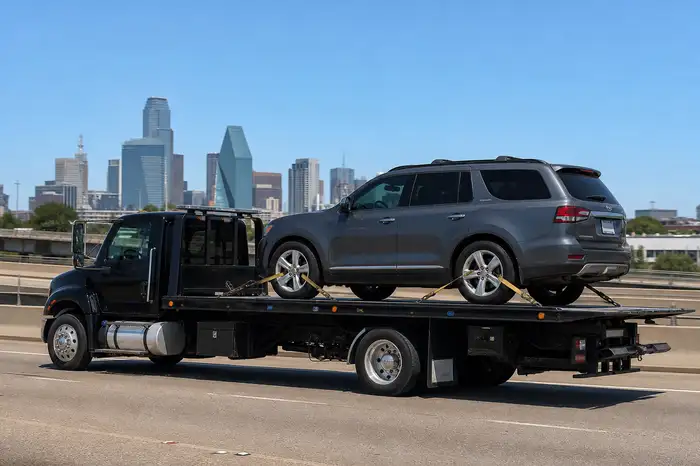
The only safe towing method for most AWD and 4WD vehicles is flatbed towing, where all four wheels are lifted completely off the ground and the entire vehicle rests on a flat platform.
With all four wheels in the air, no drivetrain components rotate. There's no torque transmitted, no heat buildup, and no wear. Your vehicle arrives at its destination exactly as it left — just without the ability to drive itself.
Our fleet of flatbed tow trucks can handle everything from compact AWD crossovers to heavy-duty 4WD pickup trucks. Whether you're stuck on I-635 in Garland or on a residential street in Lake Highlands, we dispatch the right equipment.
What About Dolly Towing?
A tow dolly lifts two wheels while the other two stay on the road. For front-wheel-drive vehicles, this is often fine — the rear wheels roll freely. For AWD and many 4WD vehicles, a dolly creates exactly the same risk as a wheel-lift: the rolling wheels put stress on linked drivetrain components.
When a dolly is acceptable for 4WD vehicles: Some older, part-time 4WD systems — common in older trucks with manual transfer cases — can be towed on a dolly if the transfer case is placed in neutral. This physically disconnects the front and rear axles, allowing the drive wheels to roll freely.
However, this varies by vehicle year, make, and model. Our operators verify with you before making any assumptions. When in doubt, we go flatbed — the extra cost is trivial compared to a transfer case replacement.
Common AWD/4WD Vehicles We Tow in Dallas
Here's a quick breakdown of how we handle some of the most common AWD and 4WD vehicles our Dallas customers drive:
- Ford F-150 4WD / Ford Expedition 4WD: Flatbed recommended unless transfer case can be placed in neutral (verify in owner's manual). Our operators are familiar with the 4x4 systems on current-generation F-Series trucks.
- Toyota 4Runner, Tacoma, Tundra (4WD): Same protocol — flatbed or confirmed neutral transfer case. The Toyota multi-mode 4WD system varies by trim level.
- Chevrolet Silverado 4WD / GMC Sierra 4WD: Flatbed is the safest choice. The AutoTrac and Active Transfer Case systems on newer models should never be towed with wheels rolling.
- Jeep Wrangler and Grand Cherokee: Flatbed strongly recommended. Jeep 4WD systems are robust but not designed for rotational stress without the engine running.
- BMW xDrive / Mercedes 4MATIC / Audi Quattro: These luxury AWD systems are always-on and have no neutral position. Flatbed only — no exceptions.
- Subaru Symmetrical AWD (Outback, Forester, Crosstrek): Flatbed only. The symmetrical all-wheel-drive system is always engaged and cannot be disconnected.
- Tesla Model Y / Model X AWD: Electric vehicles with AWD are always flatbed — never wheel-lift or dolly. See our post on towing electric vehicles in Dallas.
What Happens on Dallas Highways
When you're stuck on I-35E near Denton Drive, or on the LBJ Freeway during rush hour, you need help fast. But speed without the right equipment causes more harm than the breakdown itself.
Texas Tows dispatches flatbed trucks from central Dallas, so our response time stays tight across the metro. We cover all major corridors:
- I-35E and I-35W (the split through Dallas/Fort Worth)
- I-635 (LBJ Freeway)
- US-75 (Central Expressway)
- I-30 and I-20
- Dallas North Tollway
- TX-114 and TX-183 across Tarrant County
When you call us at (817) 512-1024, our dispatcher asks about your vehicle type. If you have AWD or 4WD, we flag it immediately and send a flatbed — not a wheel-lift.
How to Know If Your Vehicle Is AWD or 4WD
Some drivers aren't sure what they're driving. Here's how to check quickly:
- Look at the dashboard badge: AWD, 4WD, 4x4, xDrive, Quattro, 4MATIC, SH-AWD — any of these means all four wheels are driven
- Check the badging on the vehicle: Usually on the rear hatch, tailgate, or side doors
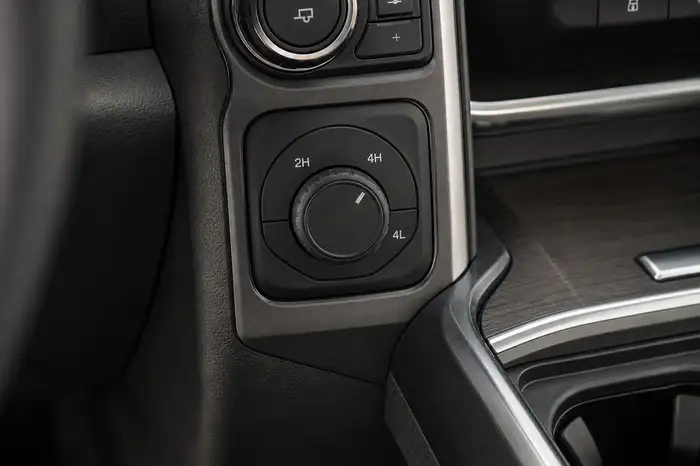
- Look for a transfer case selector: A knob or buttons labeled 2H / 4H / 4L / 4WD / AWD on the center console
- Check your owner's manual: The “Drivetrain” or “Towing” sections specify towing requirements
If you're unsure, tell the dispatcher “I don't know if it's AWD” — we'll default to flatbed, which is always the safe choice.
Signs Your Drivetrain Was Damaged During Towing
If you think a previous tow was done incorrectly on your AWD/4WD vehicle, watch for these warning signs:
- Grinding or whining noises from under the vehicle, especially when turning
- Vibration at highway speeds
- AWD/4WD warning lights on the dashboard
- Difficulty engaging 4WD or the system behaving erratically
- Burning smell from the drivetrain area
- Unusual tire wear — uneven patterns suggest the drivetrain isn't distributing torque properly
If you notice any of these after a tow, get the vehicle inspected immediately. Delaying can turn a $1,500 repair into a $5,000+ drivetrain replacement.
Towing a 4WD When You're Stuck Off-Road
Dallas drivers occasionally get into trouble off-road — whether it's a muddy trail near Lake Ray Hubbard, a flooded low-water crossing, or an off-road area in Sunnyvale. If your 4WD vehicle is stuck in terrain rather than on a road, you need a winch-out or recovery service in addition to — or instead of — standard towing.
Our winch-out service uses a heavy-duty recovery winch to extract stuck vehicles without dragging them, which protects the undercarriage and drivetrain. Once extracted, if the vehicle is driveable, you may not need a tow at all. If it needs to go to a shop, we'll set up the flatbed from there.
Calling the Right Towing Company for Your AWD or 4WD
Not every towing company in Dallas asks about your drivetrain type before dispatching a truck. Some send whatever's available. That's how expensive drivetrain damage happens.
When you call Texas Tows, we ask the right questions upfront:
- What's the year, make, and model?
- Is it AWD, 4WD, or 2WD?
- What happened — breakdown, accident, or stuck vehicle?
- Where are you located?
We match the right equipment to your vehicle every time. For AWD and 4WD vehicles, that means a flatbed — period.
If you're stranded anywhere in the Dallas/Fort Worth area, call us at (817) 512-1024. We're available 24/7, 365 days a year, and our operators know the difference between a wheel-lift situation and a flatbed situation before the truck ever leaves the yard.
Texas Tows Inc. | TDLR License #0654316VSF | 4245 N Central Expy #490, Dallas, TX 75205 | (817) 512-1024
