

Tire blowout prevention for Dallas drivers is more than routine maintenance advice — it's a safety imperative. Texas highways see some of the highest blowout rates in the country, driven by extreme summer heat, heavy traffic loads, and road surfaces that can destroy an underinflated or worn tire in minutes. Our TDLR-licensed team at Texas Tows Inc. has responded to hundreds of blowout scenes across the DFW metro since 2015, and the patterns are consistent: the majority were preventable.
Whether you commute daily on the Dallas North Tollway, run the Sam Rayburn Tollway in Plano, or regularly drive I-20 through Arlington and Grand Prairie, this guide gives you the practical steps to reduce your blowout risk — and tells you exactly what to do if prevention fails.
Why Dallas Highways Are High-Risk for Tire Blowouts
Dallas-Fort Worth has a specific combination of factors that makes tire blowouts significantly more likely than in cooler, less congested metro areas:
- Extreme summer heat: Dallas pavement surface temperatures regularly exceed 140°F in July and August — well above the 100°F threshold where tire air pressure starts to spike dangerously. High internal pressure plus heat-softened rubber equals blowout conditions.
- Heavy highway traffic: DFW is one of the most congested metros in the nation. Stop-and-go traffic on I-35E, I-635 (LBJ Freeway), and US-75 creates heat buildup in tires that doesn't dissipate the way it would at sustained highway cruising speed.
- Road surface conditions: DFW highways see heavy commercial truck traffic, which contributes to pavement degradation, ruts, and debris that can damage sidewalls and cause punctures.
- Long commuting distances: DFW's sprawl means more miles driven per resident than in most U.S. cities. More miles equals faster tire wear.
- Underinflation prevalence: NHTSA data consistently shows that roughly one in four passenger vehicles on U.S. roads is operating with at least one significantly underinflated tire. In heat, underinflation dramatically shortens the time to blowout.
According to NHTSA, tire-related crashes cause approximately 11,000 accidents and 600 fatalities in the United States annually. Texas — one of the largest driving states — accounts for a disproportionate share. Blowout prevention on Dallas highways is not optional.
Warning Signs Your Tires Are Failing
Most blowouts are preceded by warning signs that drivers miss or ignore. If you notice any of the following, pull off safely and inspect your tires before getting back on a Dallas freeway:
- Vibration through the steering wheel or seat: Low-speed vibration can indicate a tire with uneven wear, a separated belt, or out-of-balance condition. At highway speed, this vibration can escalate rapidly to a blowout.
- Pulling to one side: If your vehicle consistently drifts left or right without steering input, one tire may be significantly underinflated or have internal damage.
- Visible bulges or bubbles on the sidewall: A bulge means the internal structure of the tire has failed. This tire will blow — the only question is when. Do not drive on it.
- Tread wear indicators flush with the tread: When the wear bars (the small raised sections between tread channels) are level with the tread surface, the tire has reached its legal minimum — 2/32". Tires at this point have no wet-weather stopping capability and are highly blowout-prone under load.
- Cracking or dry rot on sidewalls: Ozone, UV exposure, and age break down the rubber compound. Sidewall cracks mean the structural integrity is compromised, especially under Texas heat stress.
- TPMS warning light: Your Tire Pressure Monitoring System light means one or more tires is 25% below recommended PSI. At that level, heat buildup is severe. Pull over and check pressures before highway driving.
- Slow leak requiring frequent re-inflation: A tire that keeps losing air has a nail, screw, or valve stem issue that will eventually fail completely — often at the worst possible time and place.
Tire Blowout Prevention Tips for DFW Drivers
The following practices significantly reduce blowout risk for Dallas highway drivers:
1. Check Tire Pressure Monthly — Not Just When the Light Comes On
Texas temperature swings between night and day can change tire pressure by 3–5 PSI. Check cold pressure (before driving more than a mile) monthly, and always before a long highway run. The correct PSI is on the sticker inside your driver's door jamb — not on the tire sidewall, which lists the maximum. Most passenger vehicles run 32–36 PSI. Add 4–6 PSI during peak Dallas summer months as a heat buffer, staying within the door-jamb range.
2. Rotate Tires Every 5,000–7,000 Miles
Uneven wear is a leading cause of blowouts. Front tires wear faster than rear tires on front-wheel-drive vehicles. Rotating tires evenly distributes wear and extends tire life. Given DFW commuting distances, plan rotations every 5,000 miles — not the maximum interval on the sticker.
3. Inspect Tires Before Every Long Highway Drive
Before driving US-75 to Plano, SH-183 through Irving, or any extended highway route, do a 60-second walk-around: check for visible damage, foreign objects in the tread, sidewall cracks, and pressure if you have a portable gauge. This habit catches nail punctures before they escalate to a blowout at 70 mph.
4. Replace Tires at or Before the 6-Year Mark
Even if tread looks adequate, tires degrade chemically with age. Texas heat accelerates this process dramatically. Most tire manufacturers recommend replacement after six years regardless of tread depth; NHTSA recommends a maximum of 10 years from the DOT manufacture date. Check the four-digit DOT code on your tire sidewall (week and year — e.g., "2324" = week 23 of 2024). If your tires are six or more years old and you drive DFW highways regularly, replace them.
5. Avoid Road Hazards — Including Ruts on DFW Freeways
Dallas roads have specific hazard zones: pothole clusters on I-30 near downtown, ruts on I-635 in Irving, and debris from commercial truck traffic on SH-114 and I-20. Scan well ahead on highways, avoid driving in ruts where possible, and steer around potholes rather than braking into them (braking into a pothole transmits the full impact to the tire and wheel).
6. Don't Overload Your Vehicle
Every tire has a load rating — the maximum weight it's designed to carry. Overloaded vehicles, especially trucks and SUVs hauling trailers or carrying heavy cargo on Texas highways, put tires over their rated capacity. Combined with heat, this is a blowout setup. Check your vehicle's GVWR (Gross Vehicle Weight Rating) and your tire's load index before hauling.
7. Keep Tires Balanced and Aligned
Out-of-balance tires cause uneven wear and highway vibration that stresses the internal structure. Wheel alignment keeps tires rolling in the correct direction, preventing edge wear. Have alignment checked whenever you hit a significant pothole or curb, or every 12,000 miles on DFW roads.
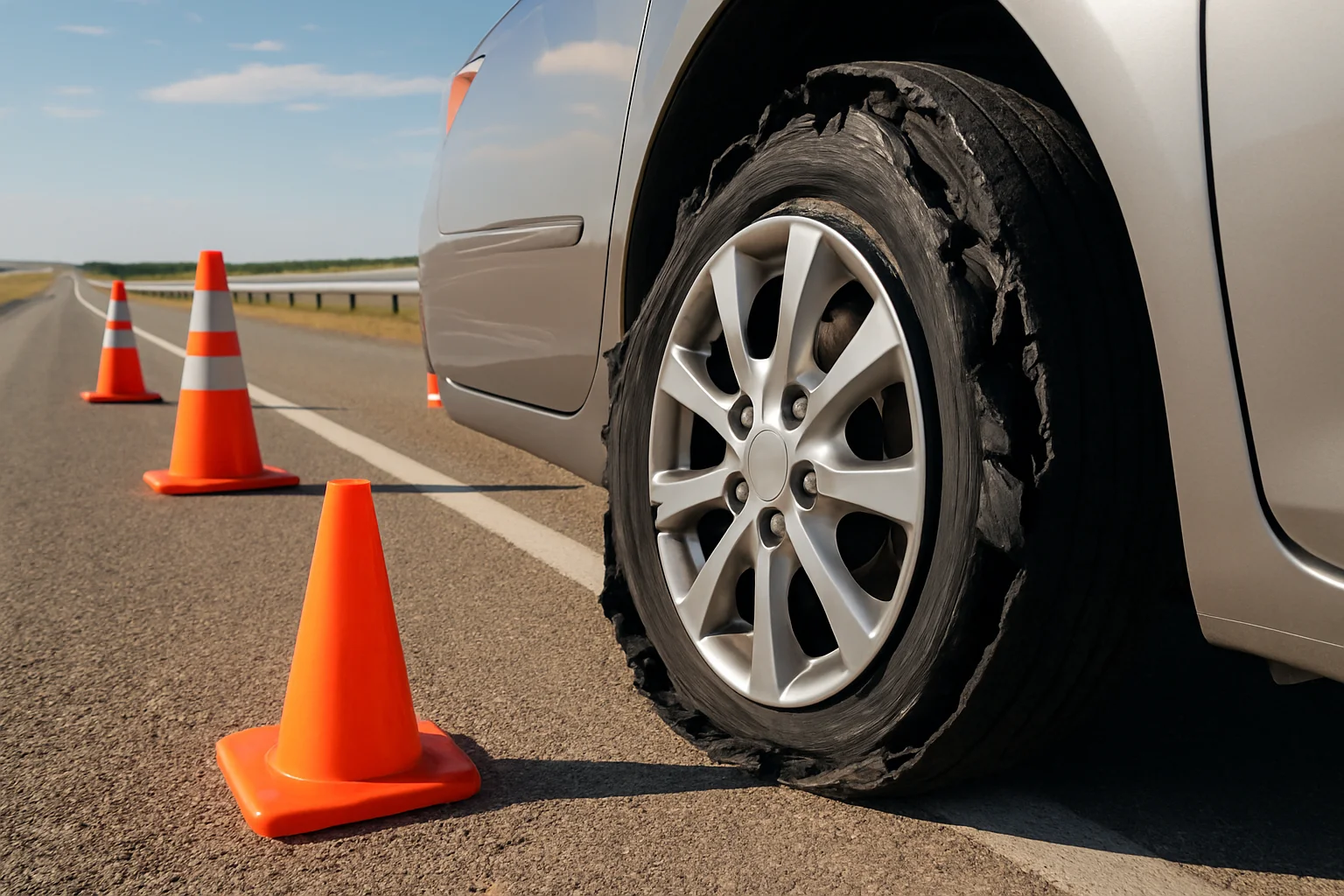
What to Do If Your Tire Blows Out at Highway Speed on a Dallas Freeway
When a tire blows at 65–75 mph, most drivers' instinct is to brake hard. That instinct is wrong and can cause loss of control. Here's the correct sequence:
- Grip the steering wheel firmly with both hands. A rear blowout will push the vehicle; a front blowout will pull it. Counteract with steady, firm steering — not jerking.
- Do NOT brake immediately. Braking at the moment of blowout transfers weight forward onto a compromised or failed tire, which can cause a spin or rollover. Maintain speed momentarily.
- Gradually release the accelerator. Let the vehicle slow naturally while you maintain steering control.
- Steer toward the shoulder. Once you've stabilized, guide the vehicle calmly toward the right shoulder. Signal your intent to other drivers.
- Brake gently once on the shoulder. Only after you're off the travel lane should you apply the brakes to bring the vehicle to a stop.
- Turn on hazard lights immediately. The moment the blowout happens, activate your hazards so other drivers know something is wrong.
- Stay in the vehicle if it's unsafe to exit. On busy DFW freeways like I-35E through downtown or the Mixmaster interchange, it may be safer to stay inside with seatbelts on than to stand on the shoulder with traffic at 70+ mph. Call for help from inside the vehicle.
- Call Texas Tows at (817) 512-1024 for immediate dispatch. Give us your location (highway name, nearest exit or mile marker), and we'll have a driver en route fast.
If you have a spare and it's safe to change the tire (daylight, stable shoulder, out of traffic), you may be able to handle it yourself. But on a busy Dallas freeway at night or in heavy traffic, calling for a tow is the safer choice — our drivers bring amber warning lights and trained positioning to get you and the vehicle off the shoulder.
When to Call Texas Tows After a Blowout
There are several blowout scenarios where calling Texas Tows is the right move rather than attempting a roadside change:
- No spare or a run-flat situation: Many newer vehicles ship without a full-size spare or any spare at all. If you only have a tire inflation kit (the can of Fix-a-Flat style sealant), it won't work on a blown-out tire — you need a tow.
- Blowout on a high-speed DFW freeway at night: Changing a tire on the shoulder of I-635 or US-75 at night is genuinely dangerous. Our drivers have amber warning lights, traffic cones, and training — call us instead.
- Rim damage: If the tire blew out and you drove on the rim (even briefly), the wheel may be damaged and the vehicle needs flatbed transport, not a tire change.
- Blowout caused an accident: If the blowout led to an accident, call 911 first, then call Texas Tows for towing service once the scene is safe. Our TDLR-licensed operators work accident scenes across DFW daily.
- You're in a high-risk location: The left shoulder of a highway, a narrow overpass, or any location where standing outside the vehicle is unsafe — call us. We can provide safety from a position that you can't.
Texas Tows covers the entire DFW metro: Dallas, Fort Worth, Irving, Arlington, Plano, Garland, Grand Prairie, Mesquite, Carrollton, Richardson, and all surrounding communities. We respond to blowout scenes on all major DFW corridors — I-35E, I-30, I-20, I-635, US-75, US-287, SH-114, the Dallas North Tollway, and Sam Rayburn Tollway. Call (817) 512-1024 anytime.
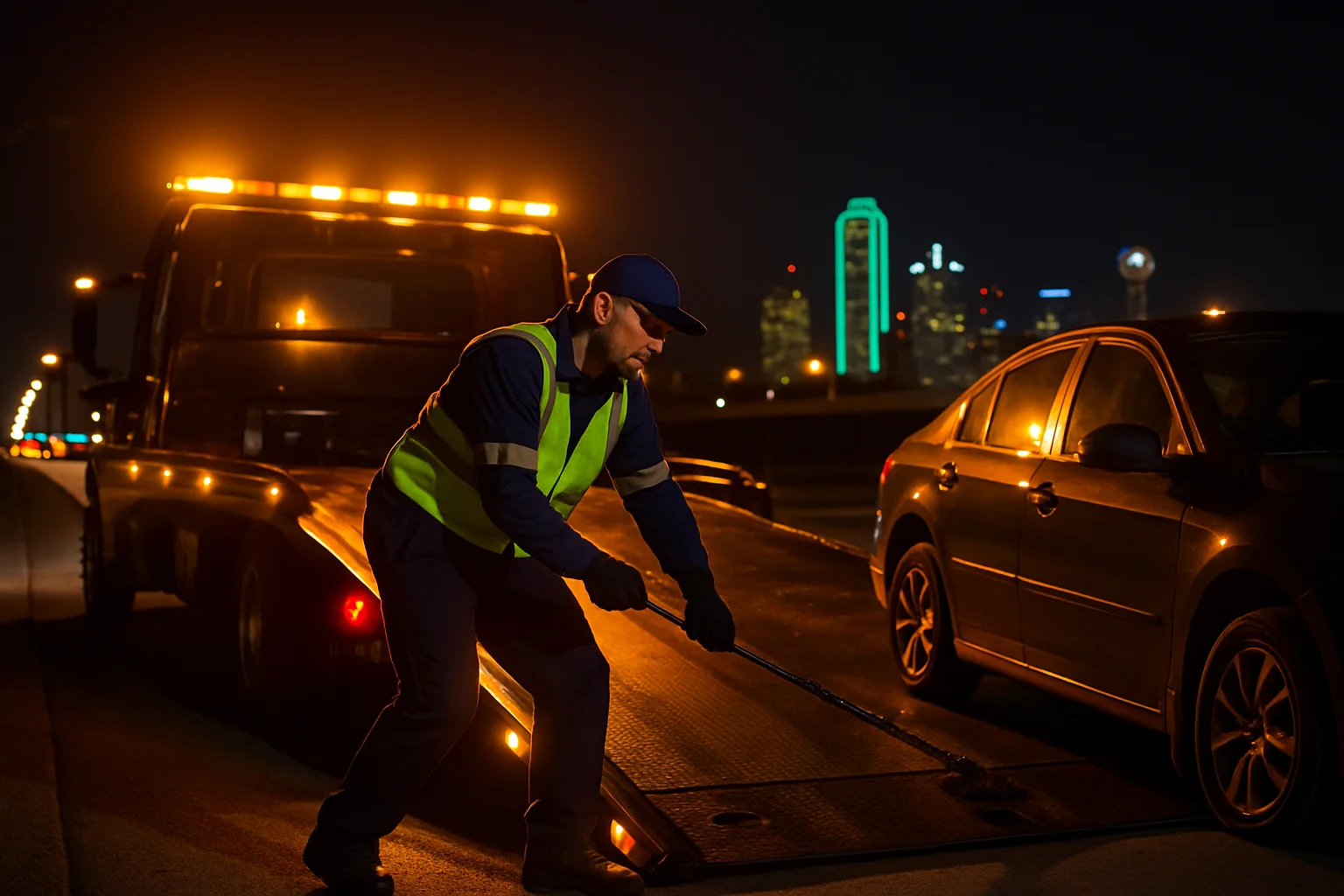
Dallas Roads and Highways Where Blowouts Are Most Common
Our Texas Tows drivers respond to more blowout calls on these DFW corridors than any others:
- I-35E (Stemmons Freeway): One of the most heavily trafficked corridors in Dallas, carrying both commercial trucks and commuters daily. Pavement conditions and heavy load traffic make this a high-risk zone, especially in the downtown merge areas near the Mixmaster.
- I-635 (LBJ Freeway): The ongoing managed lane construction has created debris zones and surface transitions that are tough on tires. The stretch through Irving and Farmers Branch has particularly rough surfaces.
- I-30 (Tom Landry Freeway): Connects Dallas to Fort Worth through Arlington and Grand Prairie. Heavily used by commercial trucks from the area's distribution corridors, leading to significant road debris.
- US-75 (Central Expressway): High-speed commuter corridor from downtown Dallas to Plano and McKinney. The narrow shoulders in several sections make blowouts particularly hazardous — calling for help rather than self-service is strongly recommended here.
- I-20 (Western Auto Trail): The southern belt through Arlington, Grand Prairie, and Duncanville carries heavy freight traffic. This corridor consistently produces blowout calls in our dispatch log.
- Dallas North Tollway and Sam Rayburn Tollway (SH-121): High-speed corridors with less forgiving surfaces. Emergency shoulder access is limited on the tolled sections, making safe pulloffs harder.
If you drive any of these roads regularly, prioritize the tire inspection and inflation checks covered above — the combination of heat, speed, and surface conditions on DFW freeways is unforgiving.
For a related guide, see our article on what to do when you get a flat tire on a Dallas highway — which covers the step-by-step for a standard flat alongside the blowout survival guide above.
FAQs: Tire Blowouts in Dallas
What causes most tire blowouts on Dallas highways?
The most common causes of tire blowouts on Dallas highways are underinflation combined with extreme summer heat, tire age beyond six years, tread worn below 2/32", internal structural damage from hitting road hazards (potholes, ruts, debris), and overloading. Texas summer pavement temperatures can exceed 140°F, which dramatically accelerates heat-related tire failure in any tire that's already compromised.
How often should I check tire pressure if I drive Dallas freeways daily?
For Dallas drivers who commute on highways daily, check cold tire pressure at least once a month — and any time you notice your TPMS light, vibration, or the vehicle pulling to one side. During peak summer months (June–September), check more frequently because temperature swings between day and night can shift pressure by 3–5 PSI, and the baseline heat-related pressure increase already stresses your tires more than in cooler climates.
Is it safe to change a tire on a Dallas freeway shoulder?
Changing a tire on the shoulder of a high-speed DFW freeway like I-35E, I-635, or US-75 carries real risk — especially at night or in heavy traffic. If you're on a wide, well-lit shoulder during daylight with light traffic, a self-service tire change may be manageable. In any other situation, call Texas Tows at (817) 512-1024. Our drivers bring amber warning lights, traffic cones, and trained positioning to protect you from passing traffic while the vehicle is towed.
What should I do immediately after a tire blowout at highway speed?
After a blowout at highway speed: grip the steering wheel firmly, do NOT brake immediately, release the accelerator gradually, steer toward the right shoulder, activate hazard lights, and only brake gently once you're off the travel lane. Do not jerk the wheel. Once safely stopped, assess whether it's safe to change the tire or whether you need to call for roadside assistance. If in doubt, stay in the vehicle with seatbelts on and call Texas Tows at (817) 512-1024.
How long do tires typically last in Texas heat?
In Texas heat, tires typically last 3–5 years of normal driving, compared to 5–6 years in cooler climates. The combination of extreme UV exposure, high pavement temperatures, and year-round driving accelerates rubber degradation. Even if your tires appear to have adequate tread, check the DOT manufacture date on the sidewall. If they are six or more years old, replace them regardless of visible wear — the internal structure may be compromised by Texas heat in ways not visible from the outside.
Can Texas Tows help with a blowout anywhere in DFW?
Yes. Texas Tows Inc. covers the full Dallas-Fort Worth metro area including Dallas, Fort Worth, Irving, Arlington, Plano, Garland, Grand Prairie, Mesquite, Carrollton, Richardson, and all surrounding communities. We respond to blowout scenes on all major DFW highways 24 hours a day, 7 days a week. Call (817) 512-1024 for immediate dispatch.
Call Texas Tows After a Blowout — 24/7 Across DFW
A tire blowout on a Dallas highway is not something to navigate alone. Whether you need a flatbed tow to the nearest shop or assistance after an accident caused by a blowout, Texas Tows Inc. is the call to make. We've handled hundreds of blowout scenes across I-35E, I-635, I-30, US-75, and every other major DFW corridor since 2015 — TDLR-licensed, fully insured, transparent pricing.
Call (817) 512-1024 anytime. We dispatch immediately.
For more on what to do after a roadside emergency, see our roadside assistance services or our towing service page.
