

A car breakdown on I-45 or I-20 near Dallas puts you in one of the most dangerous positions a driver can face. Both highways carry heavy commuter and freight traffic at high speeds — I-45 through south Dallas and DeSoto, I-20 cutting east-west through Arlington, Duncanville, Mesquite, and Grand Prairie. When your car stops on either of these corridors, the seconds and minutes immediately following determine whether you stay safe and get home, or become a secondary accident statistic.
Texas Tows Inc. has operated across the DFW metro since 2015, responding to breakdowns on I-45, I-20, I-35E, I-30, I-635, and every major DFW corridor. Our TDLR-licensed team knows these highways well — including the spots where shoulders narrow, the interchanges where traffic merges blind, and the stretches where cell service gets thin. This guide gives you the exact steps to take when your car dies on I-45 or I-20 near Dallas, and tells you what to expect when you call us.
- Why I-45 and I-20 Breakdowns Are High-Risk
- Step 1 — Pull Over Safely
- Step 2 — Stay Safe at the Scene
- Step 3 — Call for Help Immediately
- Step 4 — What to Tell the Dispatcher
- What Texas Tows Does When You Call
- Know Your Stretch of I-45 and I-20 Near Dallas
- Common Causes of DFW Highway Breakdowns
- FAQs: Car Breakdowns on I-45 and I-20 Near Dallas
Why a Car Breakdown on I-45 or I-20 Near Dallas Is High-Risk
Not all breakdowns are created equal. A car that stops in a parking lot or on a residential street is an inconvenience. A car breakdown on I-45 near Dallas or on I-20 through the DFW metro is a genuine safety emergency — and TxDOT data backs this up. Texas records hundreds of secondary crashes annually where a stopped or slow-moving vehicle on a freeway shoulder is struck by an inattentive driver.
Several factors make these corridors particularly unforgiving:
- High speed differentials: Both I-45 and I-20 carry traffic at 65–75 mph. A stopped vehicle creates a significant speed gap that drivers may not recognize until it's too late — especially at night or in heavy rain.
- Heavy truck traffic: I-20 is a major freight corridor. Semi-trucks have far longer stopping distances than passenger vehicles and less ability to swerve on a crowded highway.
- Complex interchanges: The I-45/I-20 interchange south of downtown Dallas, the I-20/I-35E split near Duncanville, and the I-20/I-635 junction in Mesquite all involve merging traffic at speed — dangerous locations if your vehicle stops near an on-ramp or weave section.
- Limited shoulders in urban sections: Through south Dallas and along the I-20 corridor through Garland, some sections have narrow or no usable shoulders. If your car can't make it to a full shoulder, your margin for error shrinks dramatically.
Understanding these risks is the first step toward handling a breakdown without becoming a casualty.
Step 1 — Pull Over Safely and Activate Your Hazard Lights
The moment you sense trouble — unusual sounds, loss of power, overheating gauge climbing, tire change in handling — your first move is to get off the travel lanes. Do this in order:
- Signal immediately and move right. Do not brake sharply. Check your mirrors, signal, and begin moving toward the right shoulder in a controlled manner. The goal is the right-hand shoulder or, if available, a full exit ramp — not the left shoulder (the left shoulder on Texas freeways is authorized only for emergency vehicles).
- Activate your hazard lights as soon as you begin moving over, not after you stop. Blinking hazards warn following traffic while you're still in transition. Under Texas Transportation Code § 547.331, hazard lights are required whenever a vehicle is disabled on or adjacent to a roadway.
- Get as far right as possible. On I-45 and I-20, push your vehicle as far onto the shoulder as you can — ideally past the white fog line and as close to the guardrail or barrier as practical. Every foot of separation between your car and live traffic matters.
- Turn your wheels to the right. If a passing vehicle strikes your car, wheels turned right direct the impact away from traffic rather than into the travel lanes.
If your vehicle dies suddenly in a travel lane and cannot be moved, remain in your vehicle with your seatbelt on and call 911 immediately. Do not attempt to push the vehicle in live freeway traffic.
Step 2 — Stay Safe at the Scene
Once you're stopped on the shoulder, your instinct may be to get out of the car and assess the damage. On I-45 and I-20, that instinct can get you killed. Texas DPS and the NHTSA consistently advise that motorists involved in highway breakdowns face significant risks outside their vehicles due to distracted and drowsy drivers who drift onto shoulders.
Follow these rules:
- Stay in your vehicle if the shoulder is wide and you are away from traffic. Keep your seatbelt fastened. A vehicle — even a disabled one — offers significant protection compared to standing in the open.
- Exit away from traffic if your vehicle is close to the travel lane. If the shoulder is narrow and you feel your vehicle could be struck, exit through the passenger-side door (away from traffic) and move behind the guardrail. Stay out of the grass median on I-20 west of Dallas — drainage ditches run along those sections.
- Set up warning triangles or road flares if you have them. Texas law recommends placing reflective triangles at 10, 100, and 200 feet behind your vehicle on freeways. Even a partial setup significantly reduces your risk.
- Turn on your interior dome light at night. Added visibility reduces the chance of a following driver misjudging your position on the shoulder.
- Do not accept help from unmarked vehicles. If someone stops to "help" and they are not law enforcement or an identified tow truck operator, do not exit your vehicle to interact with them. Keep your doors locked. Call 911 if you feel threatened.
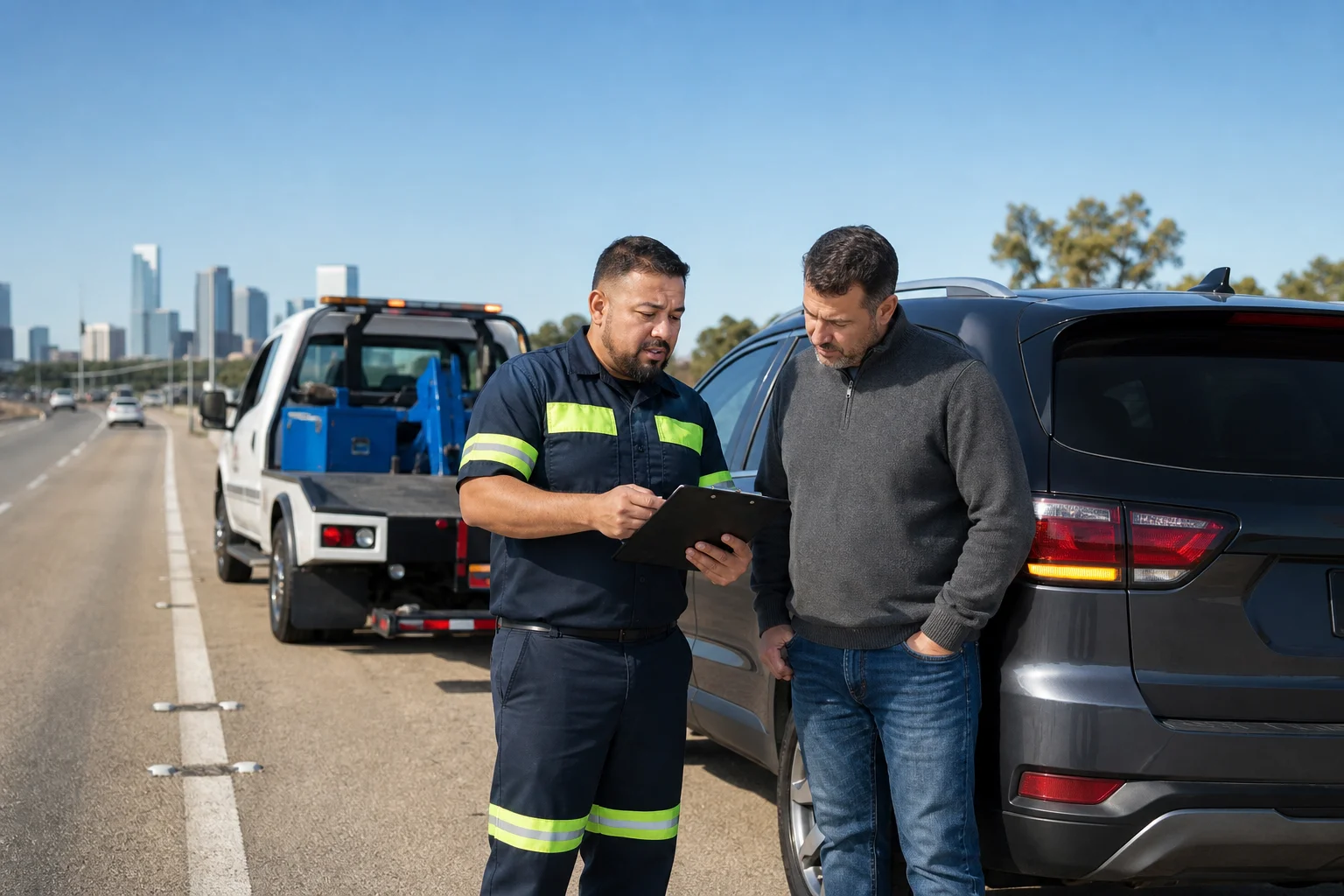
Step 3 — Call for Help Immediately
Once you're safely stopped, call for help. On I-45 and I-20 in the DFW area, you have two options:
- Call 911 first if: There are injuries, your vehicle is blocking a travel lane, you feel unsafe, or there is a fire or fuel leak. DPS or local law enforcement will respond and may request a tow themselves.
- Call Texas Tows directly: (817) 512-1024. Our dispatch operates 24/7 across the full DFW metro. Calling us directly — rather than waiting for a police-dispatched rotation tow — means you get to choose your service provider, control your destination, and avoid non-consent tow charges that can sometimes run higher than market rate.
Under Texas law, you have the right to choose your own towing company at the scene of a breakdown. If a police officer asks which company you prefer, you can request Texas Tows by name. Officers cannot compel you to use a specific company unless your vehicle is blocking traffic and you cannot reach your preferred operator within a reasonable time.
If you're a AAA member or carry a roadside assistance add-on through your auto insurer, you can call them as well — but response times on I-45 and I-20 through contracted networks vary. Texas Tows dispatches from multiple DFW locations, giving us faster access to most I-45 and I-20 breakdown locations than a national network using a single local contractor.
Step 4 — What to Tell the Dispatcher
The faster and more accurately you communicate your situation, the faster help arrives. When you call Texas Tows — or any roadside operator — have this information ready:
- Your exact location. Highway, direction (northbound/southbound or eastbound/westbound), and the nearest milepost marker, exit number, or overpass. On I-45, mile markers run south to north (higher numbers north of Dallas); on I-20, they run west to east. Look for green highway marker signs on the shoulder.
- Your vehicle description. Year, make, model, and color. This helps our driver spot you quickly on a busy highway shoulder.
- The nature of the problem. Dead battery, flat tire, overheating, engine failure, or unknown. This tells us what equipment or service to dispatch.
- Number of passengers, especially if you have children or elderly passengers who may need priority.
- Your phone number so the driver can call or text as they approach.
Our dispatch team will give you an ETA and keep you informed if traffic delays our driver. Do not leave your vehicle before our driver arrives — if you walk along the shoulder of I-45 or I-20 to find a call box or better signal, you increase your exposure to highway traffic.
What Texas Tows Does When You Call for a Car Breakdown on I-45 or I-20
When you call Texas Tows for towing service or roadside assistance on I-45 or I-20, here is what happens:
- Dispatch locates the nearest available unit with the right equipment for your situation. If the vehicle cannot be driven safely, we send a tow truck or flatbed.
- Our driver calls or texts your phone with an estimated arrival time and may request updated location coordinates if your breakdown is in a section with inconsistent milepost signage.
- On arrival, the driver assesses the situation with hazard lights and protective positioning behind your vehicle. We do not rush the hookup process — proper vehicle securement on a live highway takes a few minutes, and it prevents further damage in transit.
- We confirm your destination before loading. You choose where your vehicle goes — your home, your mechanic, or a dealership. We do not tow to facilities you didn't authorize.
- You receive an itemized receipt at the time of service, which documents the service type, mileage, and all charges. This receipt is what your insurance company or motor club needs to process a roadside assistance reimbursement claim.
We serve Dallas, Fort Worth, Irving, Arlington, Plano, Garland, Mesquite, DeSoto, Duncanville, Grand Prairie, Carrollton, Richardson, and all surrounding DFW communities — any breakdown on I-45 or I-20 falls within our service area.
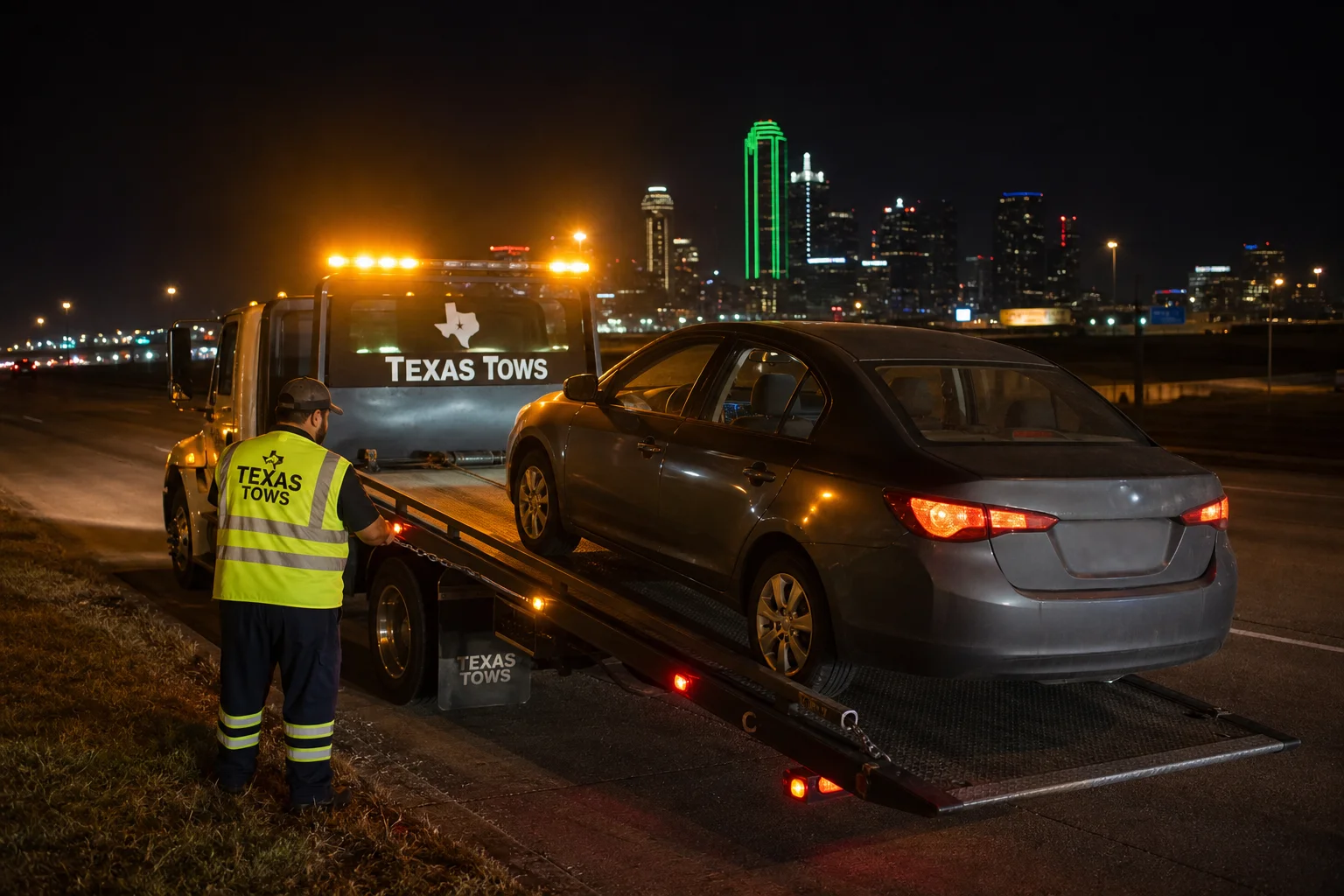
Know Your Stretch of I-45 and I-20 Near Dallas
I-45 and I-20 cover a lot of ground through the DFW metro. Knowing the specific character of the section you drive most often helps you react appropriately if you break down.
I-45 Near Dallas — Key Sections
- I-45 through downtown Dallas (the "Stemmons Connector" connection area): Urban section with close lane spacing and frequent merges near the I-45/I-30 interchange. Shoulders are usable but narrow in places. Very high volume during rush hours.
- I-45 south through South Dallas, DeSoto, Lancaster: More open highway geometry with wider shoulders in most stretches. Higher speeds — most of this section is 70 mph. Flash flooding risk near the Wilmer/Hutchins area during heavy rain; a breakdown here during a storm significantly elevates risk.
- I-45 at the I-20 interchange (south Dallas): One of the busiest interchanges on the southern DFW freeway system. Weaving zones here are treacherous. If your car stops near this interchange, getting past the interchange onto a straight shoulder section before stopping is worth the extra distance if your car will roll.
I-20 Near Dallas — Key Sections
- I-20 through Arlington and Grand Prairie: Heavy commuter traffic in both directions during peak hours. The I-20/I-360 and I-20/SH-183 interchanges are particularly busy. Shoulders are generally adequate through this section.
- I-20 through Duncanville and Cedar Hill: Hilly terrain with grades that stress cooling systems — overheating breakdowns are more common here during Dallas summer heat. Multiple full exits and frontage roads make it easier to get off the main lanes if you have any warning before the breakdown.
- I-20 through Mesquite and Garland (east of Dallas): Industrial and warehouse corridor. High truck traffic. Breakdown here on a weekday can mean company within seconds from a passing trucker or law enforcement — but the truck volume also means you should stay well clear of the travel lanes.
- I-20/I-635 interchange in Mesquite: A complex, multi-level interchange with minimal shoulder space in the transition zones. Avoid stopping here at any cost — if your car is failing near this interchange, push to the nearest straight section.
Common Causes of Car Breakdowns on DFW Highways
Understanding what causes most DFW highway breakdowns helps you prevent them — or at least recognize the warning signs early enough to exit safely.
- Dead battery: Dallas's extreme summer heat accelerates battery degradation. Most batteries last 2–3 years in DFW conditions vs. 4–5 years in cooler climates. Batteries often fail at startup but can also fail during highway driving if the alternator cannot maintain charge. See our full guide on what to do when your car breaks down in Dallas for battery-specific steps.
- Flat tire or blowout: Highway speeds amplify the danger of a flat. A blowout at 70 mph on I-20 creates sudden vehicle instability — do not slam your brakes. Maintain steering and gradually reduce speed. If it is not safe to drive, call for a tow to a tire shop rather than attempting a change on a live highway shoulder.
- Overheating: The 100°F-plus Dallas summers push cooling systems to the limit. Signs include the temperature gauge climbing above normal range, steam from under the hood, and a burning smell. At the first sign of overheating, turn off the A/C, turn on the heater (it bleeds engine heat), and exit the highway at the next opportunity.
- Out of fuel: A surprisingly common highway breakdown in DFW, especially on I-45 south of Dallas where exit spacing increases. If you cannot safely reach a station, our roadside assistance team can tow you to the nearest safe stop.
- Transmission or engine failure: A sudden loss of power on the highway — engine cuts out, car decelerates rapidly — indicates a serious mechanical failure. Do not attempt to restart the engine repeatedly; use whatever remaining momentum to get to the shoulder and call for a tow.
- Electrical system failure: Loss of power steering, sudden instrument cluster dropout, or windows and locks failing mid-drive can indicate alternator or electrical issues. These often precede a full battery drain failure within minutes.
FAQs: Car Breakdowns on I-45 and I-20 Near Dallas
What should I do first if my car breaks down on I-45 near Dallas?
Activate your hazard lights immediately and move to the right shoulder as safely as possible. Do not brake suddenly — signal and gradually steer right. Once stopped, stay in your vehicle with your seatbelt fastened (unless you are dangerously close to traffic, in which case exit away from traffic and move behind the guardrail). Then call Texas Tows at (817) 512-1024 or 911 if there are injuries or your vehicle is blocking a lane.
How long does it take Texas Tows to reach a breakdown on I-20?
Our typical response time for a car breakdown on I-20 near Dallas is 30–45 minutes, depending on your location and current traffic conditions. During peak rush hours (7–9 a.m. and 4–7 p.m.), times can run longer in high-congestion sections. We dispatch from multiple DFW locations and will give you an honest ETA when you call — we do not provide artificially short estimates.
Can I stay in my car when I break down on the highway in Texas?
In most cases, yes — staying in your vehicle is safer than standing outside on I-45 or I-20. Keep your seatbelt on and your hazard lights running. The exception is if your vehicle is too close to the travel lanes or you see signs of fire or fuel leakage — in those cases, exit through the passenger-side door away from traffic and move to a safe distance behind the guardrail.
Do I have to use the tow company the police dispatcher sends?
No. Texas law gives you the right to choose your own TDLR-licensed towing company. If police are present and ask which company you prefer, you can name Texas Tows. The only exception is if your vehicle is actively blocking traffic and your chosen company cannot arrive within a reasonable time — in that situation, officers may authorize a rotation tow to clear the roadway for safety reasons.
What if my car breaks down on I-45 at night?
A nighttime breakdown on I-45 near Dallas requires extra caution. Turn on your interior dome light to make your vehicle more visible from a distance. If you have road flares or reflective triangles, place them behind your vehicle as far back as is safe. Avoid standing outside your vehicle. Call Texas Tows immediately — we operate 24/7 and respond to I-45 breakdowns at all hours. Keep your phone charged; if you are running low on battery, put it on low-power mode until help arrives.
Does insurance cover a tow from I-20 or I-45 near Dallas?
If you carry a roadside assistance rider on your auto policy or belong to AAA or a similar motor club, the tow from I-20 or I-45 is likely covered up to your policy's per-incident limit. If the breakdown followed an accident, the tow may be covered under your collision coverage (subject to your deductible) or under the at-fault driver's liability coverage. Basic Texas liability insurance alone does not cover towing your own vehicle. Texas Tows provides an itemized receipt at the time of service for use in your reimbursement claim.
Broke Down on I-45 or I-20? Call Texas Tows — 24/7 DFW Response
A car breakdown on I-45 or I-20 near Dallas is not something to navigate alone. Our TDLR-licensed team has worked every section of both highways — from the I-45/I-20 interchange south of downtown to the I-20 corridor through Arlington, Duncanville, and Mesquite — and we know how to reach you fast and get you home safe.
TDLR-licensed. Flatbed and tow trucks available. Transparent, itemized pricing. No surprise charges.
Call (817) 512-1024 anytime. We respond 24 hours a day, 7 days a week, across the full DFW metro.
For more on what to do when your vehicle fails on a Dallas highway, see our towing service page, our roadside assistance services, or our guide on what to do when your car breaks down in Dallas.
