

After a collision in Dallas, the tow truck that shows up matters — a lot. Many drivers don't realize there are two fundamentally different types of tow trucks, and using the wrong one on a crash-damaged vehicle can turn a manageable repair bill into a total loss. If your vehicle was in an accident, flatbed towing is almost always the correct choice. Here's why — and what to do if a tow operator tries to use a wheel-lift instead.
Flatbed vs. Wheel-Lift: What's the Difference?
A wheel-lift tow truck works by hooking a metal yoke under two of your vehicle's wheels (usually the front or rear) and lifting that end off the ground. The other two wheels remain on the road and roll along as the truck drives. This method is fast, inexpensive, and works fine for many everyday tows — a car with a dead battery, a disabled vehicle on a residential street, or a drivable car that needs a short move.
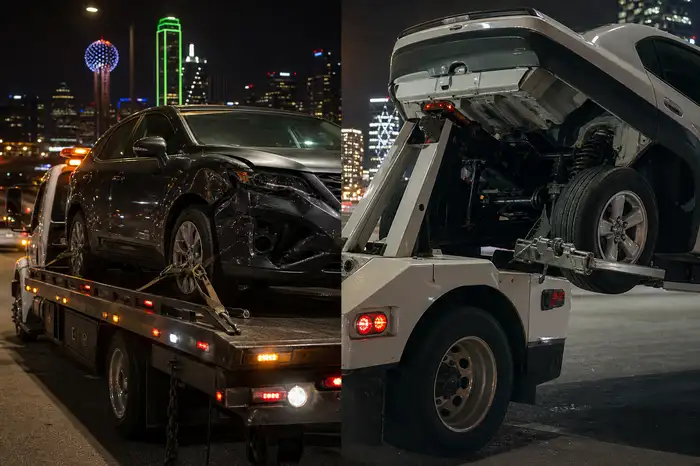
A flatbed tow truck (also called a rollback or slide) uses a hydraulic platform that tilts to the ground. The entire vehicle drives or winches onto the deck and is secured with straps — all four wheels completely off the pavement for the entire trip. Nothing rolls. Nothing drags. The car rides on the truck, not behind it.
For crash-damaged vehicles, that difference is critical.
Why Wheel-Lift Is Dangerous After a Crash
A collision changes your vehicle's structural integrity in ways that may not be visible from the outside. Here are the specific risks when a damaged car is towed on a wheel-lift:
- Steering and suspension damage: Even a moderate front-end impact can bend tie rods, crack ball joints, or shift wheel alignment. When the front wheels roll on the road under a wheel-lift tow, a compromised steering system can suddenly fail — causing the vehicle to veer unpredictably and potentially collide with another vehicle or barrier.
- Drivetrain damage on AWD and 4WD vehicles: On all-wheel-drive and four-wheel-drive vehicles, all four wheels are mechanically linked. Towing one end while the other rolls forces the drivetrain to rotate — which on a disabled AWD system can destroy differentials, transfer cases, and CV joints. Many AWD vehicles require flatbed towing even when undamaged; after a crash, it's non-negotiable.
- Frame and unibody stress: Modern vehicles use unibody construction. A collision concentrates stress in the crumple zones. Lifting one end of the vehicle and dragging it creates additional bending forces on an already-compromised structure — sometimes causing secondary cracking or deforming door frames mid-tow.
- Fluid leaks hitting the road: A crash can rupture fuel lines, transmission fluid lines, or power steering reservoirs. When the vehicle rolls during a wheel-lift tow, those fluids drip onto the highway — creating a hazard for other drivers and potentially an ignition risk.
- Airbag and sensor interference: Post-collision, the vehicle's computer systems are often in a fault state. Vibration from rolling wheels can trigger additional airbag deployment or corrupt sensor data in ways that affect the collision repair assessment.
What Texas Law Says About Post-Accident Towing
Texas doesn't mandate flatbed towing in every accident scenario, but TDLR (Texas Department of Licensing and Regulation) towing regulations do require that tow operators use methods appropriate to the vehicle's condition. Under Texas Occupations Code Chapter 2308, a tow operator who damages your vehicle during the tow can be held liable — and using improper equipment on a crash-damaged car is a clear path to that liability.
More practically: your collision insurance or the at-fault driver's liability coverage will typically cover a flatbed tow from the scene. Insurance adjusters and body shops generally require flatbed documentation for proper accident recovery. If an operator suggests a wheel-lift to save time or money, that's a red flag.
When Is a Wheel-Lift Acceptable After a Crash?
There are narrow cases where a wheel-lift is acceptable post-collision:
- The damage is purely cosmetic (dents, scratches) with no structural, mechanical, or drivetrain impact — confirmed by the driver and verified by the operator.
- The vehicle is being moved an extremely short distance (e.g., clearing an intersection) and will immediately be re-assessed.
- The flatbed is unavailable due to an active safety emergency, and a very short wheel-lift move is necessary to clear traffic — followed by a proper flatbed tow.
In most real-world accident scenarios in Dallas, a flatbed is available within a reasonable response time. Texas Tows Inc. dispatches flatbed trucks as the default for all accident calls — not as an upgrade.
Vehicle Types That Always Require Flatbed After a Crash
Even before factoring in collision damage, these vehicle types should always be flatbed-towed:
- AWD and 4WD vehicles — Chevrolet Traverse, Ford F-150 4WD, Toyota RAV4 AWD, Subaru Outback, Jeep Grand Cherokee, etc. Rolling any wheel during a wheel-lift tow damages the drivetrain on most AWD systems.
- Luxury vehicles — Audi, BMW, Mercedes-Benz, Porsche, and similar vehicles often have air suspensions, active differentials, and low ground clearance that make wheel-lift contact risky even without crash damage.
- Electric vehicles — EVs cannot be towed on a wheel-lift with the other wheels rolling. Doing so activates the motor and can damage the drivetrain or trigger regenerative braking issues. Tesla, Rivian, Chevy Bolt, and similar EVs must always go on a flatbed.
- Lowered vehicles and modified suspensions — Low clearance makes it difficult to safely position wheel-lift equipment; flatbed is required.
What Happens If Your Car Is Towed Incorrectly After an Accident?
If a tow operator uses a wheel-lift on your crash-damaged vehicle and causes additional damage, you have legal options:
- Document everything at the scene — photograph the vehicle's condition before the tow begins. Note the tow operator's name, company, TDLR license number (required on all Texas tow trucks), truck number, and time.
- Request a flatbed — you have the right to request specific equipment for a consent tow (a tow you authorize). If the operator refuses and you believe your vehicle requires a flatbed, you can decline the tow and call a different company.
- File a TDLR complaint — if an operator caused damage through improper towing, file a complaint at tdlr.texas.gov. TDLR investigates towing violations and can suspend or revoke operator licenses.
- Pursue civil liability — under Texas Occupations Code §2308.408, tow companies are liable for damage caused during a tow. Your collision insurer or the at-fault driver's insurer may pursue the tow company for additional damage caused by improper equipment.
How Texas Tows Handles Accident Recovery in Dallas
Texas Tows Inc. has been serving Dallas since 2015. Our accident recovery process starts with a flatbed as the default. When our dispatcher takes your call, they'll ask about the type of vehicle and the nature of the collision — not to upsell equipment, but to make sure the right truck is dispatched from the start.
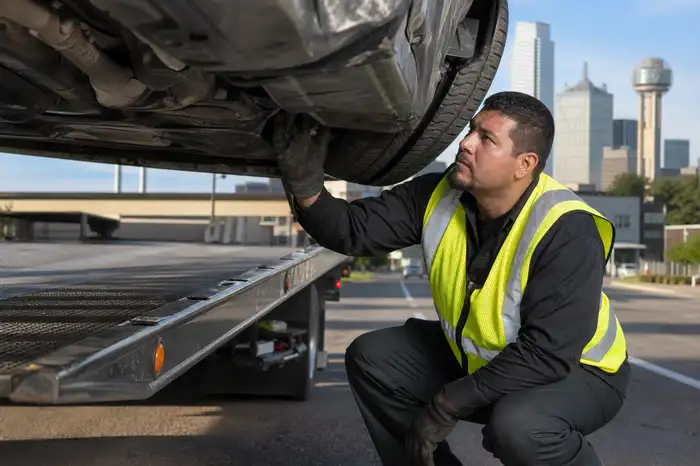
Our flatbed towing fleet includes low-profile rollbacks capable of loading vehicles with front-end damage, deployed airbags, and restricted steering. Our TDLR-licensed operators (license #0654316VSF) are trained in post-collision load assessment — checking for fluid leaks, structural compromise, and proper tie-down placement before the vehicle leaves the scene.
We also handle secondary tows — situations where your vehicle was moved improperly by a first responder tow and needs to be relocated safely to a body shop or storage facility. If you're dealing with a vehicle that was already towed and you're concerned about additional damage, call us for an assessment.
Dallas Highway Accident Response
Dallas highways — I-75, I-30, I-635 (LBJ), the Dallas North Tollway, and the George Bush Turnpike — see thousands of collisions each year. Texas Tows responds on all of these corridors, 24 hours a day, seven days a week.
One important note for Dallas drivers: DPD response times for non-injury accidents on congested highways can run 45–90+ minutes. Under Texas Transportation Code §550.062, you are not required to wait for police if no one is injured and both vehicles can be moved. You can legally call a flatbed tow before officers arrive — and doing so often clears the scene faster, reducing secondary collision risk.
If you're in an accident and need accident recovery in the North Dallas, Lake Highlands, or Medical District areas, call Texas Tows directly. Don't wait for a non-consent tow from a company you didn't choose.
The Bottom Line
After a crash, your vehicle has been through a traumatic mechanical event. The tow that follows should protect what's left — not add to the damage. Flatbed towing keeps all four wheels off the ground, eliminates drivetrain stress, prevents secondary structural damage, and ensures the vehicle arrives at the body shop in the condition it left the scene.
If a tow operator shows up at your accident scene with a wheel-lift and no flatbed, ask questions. You have the right to request appropriate equipment, and in most cases, a flatbed is available. Texas Tows operates flatbed trucks across the Dallas metro — call (817) 512-1024 for 24/7 accident recovery dispatch.
